Showing posts sorted by date for query bach. Sort by relevance Show all posts

Saturday, February 23, 2013

Transcriptions album available at Bandcamp


This month I released my first album on bandcamp, an EP of six transcriptions of classical works that I've made over the last decade or so.  Five of the pieces are by J. S. Bach, no surprise given the number of posts that I wrote about him over the duration of this blog.  Four of the five are readings from the Art of Fugue, which I also wrote about more than once.  I worked for a long time on a completion, making serious headway on the first three fugues, but ended up getting bogged down in selecting a completion. Tired of the whole thing, I back-burnered the idea of transcriptions for a while.  But it still seemed attractive, and last fall I arranged one of my favorite chorale preludes, Wachet Auf, and one of my favorites from Felix Mendelssohn's Songs Without Words, a piece that I could never play to my satisfaction on the piano.  For the time being, I think my desire for classical transcriptions is sated.  So while I work on other projects, I've had this set mastered by Taylor Deupree, and released it as a free download.

Wednesday, March 9, 2011

Sweet Cello


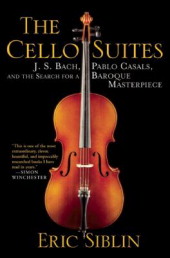
My latest side trip into the world of J. S. Bach is a paperback I picked up on a whim at our local indie bookshop: The Cello Suites by Canadian journalist Eric Siblin. I was previously unfamiliar with these suites except from guitar or lute transcriptions. Emusic has an excellent recording by Pierre Fournier on DGG Archiv for a decent price, so I availed myself of the opportunity. A wise move, because both book and music are excellent.

Siblin first encountered the cello suites at a recital selected by chance during the unwinding of a pop music critic stint at the Montreal Gazette. The program notes mentioned that no original manuscript of the suites has been located, and Siblin's journalistic interest was piqued. Nine years later, Siblin published his book, a parallel biography of Bach and Pablo Casals, the cellist who introduced the suites to the world. Bach wrote six cello suites, so Siblin divided his book into six parts, one for each suite. The suites each have six movements, following a standard sequence, starting with a Prelude, Allemande, Courante, Sarabande and concluding with a Gigue. The fifth movement varies between Minuet, Bourrée, or Gavotte. Siblin also subdivided each chapter into the suites' six movements, three for Bach, two for Casals, and reserving the ultimate gigue for the story of his quest.

Siblin shifts perspective in the Bach chapters so that the cello suites are never far from view even as his attention wanders over a wide range of topics, from biography of Bach and his descendants to reception history. Scholars place their genesis during Bach's tenure at Köthen, where he wrote much of his virtuoso keyboard and secular music. So Siblin has a chapter on the political forces that had caused excellent musicians to migrate to Köthen from Berlin, an example of a historical context that Siblin deploys throughout the book. A Near Eastern flourish in the prelude to the fourth suite leads to a digression on whether Bach might have ever heard Jewish music. Each chapter has an entertaining or illuminating anecdote, and together they give a multi-dimensional perspective on these suites.

The Casals chapters of necessity covered world history since Casals was an outspoken peace activist after the experience of WWII and the Spanish Civil War. He discovered the suites while he was foraging used sheet music stores in Barcelona when he was thirteen, and they became a lifelong trademark work. He made his first recording of the suites in 1936 while in exile to England, when the Battle of Madrid was raging. After the war, he refused to play in countries that supported, or even recognized, Franco, including the United States. He broke his vow only in 1958, when he performed in Manhattan as part of a United Nations concert, alarmed by the threat of nuclear war.

The personal reflections in the gigue chapters gave the book a depth of character that went beyond the biographies (and in Bach's case, informed speculation) of the two musical giants. Siblin learned a prelude on guitar, joined a community choir to sing a cantata, and even took a couple of cello lessons, all to get a deeper appreciation for Bach's music. His drive, coupled with the dual biographies, propelled the book forward, made me eager to read another chapter. Siblin's background in journalism informed his writing and made the book easier to read. Between his writing style and the short chapters, The Cello Suites is an entertaining read that I could read late at night when a scholarly book would have required too much concentration.

Saturday, September 11, 2010

Step away from the computer

We have major travel rapidly approaching, and my access to the internet will be sporadic at best. I'll post a picture if I can, but comment moderation is unlikely. My iPod is stocked with new music and some old favorites in anticipation of some long plane flights. I've treated myself to some noise cancelling headphones, so I hope to hear some late Feldman, maybe the studio recording of Grisey's Les Espaces Acoustiques. I've got Rifkin's version of Bach's B minor mass, Golijov's La Pasión Según San Marcos, couple of Bruckner and Sibelius symphonies, some broadcast recordings of Arvo Pärt's choral music, symphonies by Vasks and Tüür, …. I find myself drawn to classical music on airplanes, and I have high hopes for these new headphones for actually being able to hear the music.

Highbrow reading material is Céline's Journey, which I read in French during my university years, but this time in the Manheim translation; and George Prochnik's In Pursuit of Silence. I won't even contemplate the convoluted rationales of reading this book while listening to noise cancelling headphones. Somewhat fluffier fare, new fun reading from Carl Hiaasen and Don Winslow.

See you in a couple of weeks.

Monday, August 16, 2010

Bach Transcriptions at the BBC Proms

I've written before about the joys of Bach transcriptions, and one of the BBC Proms concerts this year programmed a delightful set of Andrew Litton conducting the Royal Philharmonic Orchestra, streaming for a few more days here. In addition to ever popular works like Respighi's version of the Passacaglia and Fugue, the program includes a suite by William Walton and new commissions from younger composers Alissa Firsova and Tarik O'Regan.

Saturday, July 3, 2010

Open Bach

For as much as I love, have written about, and continue to listen and perform the music of John Cage, I'm equally drawn to the music of Johann Sebastian Bach, in many ways Cage's polar opposite. Cage composed with chance operations, and some of my favorite Cage works (like the number pieces) produce sound events differently at every performance, epitomizing what has come to be called "open form." Bach's music presents an inexorable logic, to the point with his fugues where the harmonic and contrapuntal possibilities are contained within the first few measures, which might be considered the ultimate closed form.

Yet Cage selected Bach's The Art of Fugue as an early example of indeterminate music in his lecture "Composition as Process" because it was originally published as an open score, each voice on its own stave and with the instrumentation unspecified. "Timbre and amplitude characteristics of the material, by not being given, are indeterminate," he wrote. "This indeterminacy brings about the possibility of a unique overtone structure and decibel range for each performance of The Art of Fugue." And indeed, contemporary recordings of the work exist for orchestra, keyboard (piano, harpsichord and organ), string quartet, wind quintet, saxophone quartet, and many other combinations. Despite a now prevailing scholarly opinion that The Art of Fugue was written for keyboard, its open score has seemingly licensed a timbral imagination that exceeds the normal orchestral transcriptions that one finds for Bach's organ works. (The orchestral versions of The Art of Fugue that I've heard are in fact relatively colorless compared to, say, Schoenberg's transcription of the St. Anne Prelude and Fugue or Webern's magnificent transcription of the ricercar from A Musical Offering.) And I confess, I have embarked on my own set of realizations on the computer, having completed four of the set to date, half simulating acoustic instruments and half for overtly synthetized sources.

One of the most commonly known trivia about The Art of Fugue is that the last fugue in the set, a quadruple fugue erroneously entitled "fuga a tre soggetti" (fugue on three subjects) in the first edition, was unfinished at Bach's death in 1750. The first edition, published by Bach's sons a few years later, closes with the music trailing off into nowhere and a note in the handwriting of C. P. E. Bach, "N.B. While working on this fugue, in which the name BACH appears in the countersubject, the author died." The vast majority of The Art of Fugue recordings perpetuate this message, breaking off in mid-phrase. The first editors stuck in a chorale that Bach dictated from his deathbed to terminate The Art of Fugue, but it's clearly unrelated to the rest of the work and therefore seldom recorded.

In a gesture that might be seen as hubris, some musicians and scholars have attempted to complete this fugue. My love of Bach was instilled by the English composer, musicologist and critic Donald Francis Tovey, whose 1924 edition of Bach's Well-Tempered Clavier includes detailed and entertaining commentaries for each piece. This edition, still in print from the Royal Schools of Music in London, was the first Bach music I studied, and his commentary was as much a part of the education as learning the music. I knew Tovey had published a completion in 1931, but it's fairly difficult to locate even though his monograph Companion to The Art of Fugue is available at many used book shops (generally for an exorbitant price). After several unsuccessful attempts at obtaining Tovey's completion through inter-library loan, I finally located one fairly cheap from a used bookseller in England, and it's now part of my library. Tovey wasn't the only one to attempt a completion of Bach's final fugue. Probably the most well-known version is by the composer and virtuoso pianist Ferruccio Busoni. Busoni actually incorporated the whole fugue into his Fantasia Contrappuntistica, a massive twelve-part piano piece published in 1910. I've got a recording of the piece, and it sounds a lot more like Busoni than Bach, and I'm a bit repelled by the piece's virtuosic nature.

The most recent scholarly research puts forward that Bach was considerably more open about The Art of Fugue than even Cage had thought, specifically that Bach deliberately left the final fugue unfinished as a puzzle for performers to complete. Bach left us other puzzles, including but not limited to the "quaerendo invenietis" canons from The Musical Offering. Printed on a single stave but with two clefs, a tenor clef right side up and a bass clef upside down, Bach's directive to "seek and ye shall find" incites two performers facing each other across the score to devise a solution. An organist from New Zealand, Indra Hughes, uses numerology, handwriting analysis, and solid detective evidence to support his thesis that Bach had a solution to the final fugue, which I find fairly compelling. Bach wrote many of his works for didactic purposes, and Hughes suggests that The Art of Fugue belongs in large measure in this category, a compendium of fugal technique, so that the completion of the final fugue was left as an exercise for the students.

Tovey and Busoni may be the most celebrated final fugue finishers, but recent years have seen other performers release their own completions. The Henle edition of The Art of Fugue was edited by harpsichordist Davitt Moroney, who includes his version. Organist Michael Ferguson from St. Paul, Minnesota, published one and has included it in an organ recording of the entire The Art of Fugue. The Hungarian composer and organist Zoltàn Göncz also used higher mathematics to demonstrate its permutational matrix. His version of the score comes with an endorsement from Györgi Ligeti, who taught counterpoint and fugal technique. Hughes' thesis doesn't include a completion, but he extends the numerological analysis to show how long he thinks the completion should be, along with where the four themes should show up, both normal and inverted.

So, as I hinted three years ago, my summer project is an orchestration of this final fugue. It's one of Bach's longest fugues, so I still have plenty of time to decide whose completion I'll use — I've always been curious to hear Tovey's. But who knows, maybe I'll compose my own….

Friday, January 1, 2010

Adios 2009!

It's that time again, to look back and reflect on the music and events from the past twelve months. Staggeringly, I acquired almost twice as much new music this year compared to 2008, largely through the discovery of web sites and blogs that make available bootleg radio broadcasts. This had the unfortunate side effect of reducing the number of netlabel releases that I was able to absorb, because there are only so many hours in the day. However, it also had the impact of increasing the amount of contemporary classical music I heard, since most of the boots were otherwise unrecorded new music. A somewhat depressing consequence is that I looked over the list, and several times asked myself, what's that? I don't remember anything about that one!

Another shift in my listening habits, especially in the last quarter of the year, is that I've started listening more to CDs than downloads. I've been a staunch advocate for downloads for years, and even got into a bit of a flamefest on the ambient mailing list on the subject. And yet, it bothers me that I listen so much to downloaded music in preference to recordings that cost considerably more than the downloads, and which sit largely forgotten on the shelf. This change in attitude is perhaps a response to emusic's two-pronged price increase, not only charging 40% more per download, but forcing the use of twelve credits for an album if the album has any tracks longer than ten minutes. Even though I've kept my subscription, and even though I recognize that paying a quarter for an album is unfair, the luster has fallen off the pumpkin with this service.

Albums that made an impression this year (album links to reviews I wrote) include:


I eagerly look forward to the new music of 2010, and wish everyone a happy and safe new year.

Saturday, June 20, 2009

Plastic canons

One of the most thorough electronic music packages I've ever seen is the boxed set of "The Complete Tape Music of Dick Raaijmakers," which includes three CDs and a 200-page hardbound book of bi-lingual (English and Dutch) notes explaining the pieces. The pieces date from 1959 to 1996, and although a lot of analog electronic music sounds a bit dated, I find Raaijmakers' work not only listenable, but very prescient. In particular, I am fascinated by a series of five canons from the mid-1960s, all of which sound much more like static or noise than any of their contemporaries. The canons are artifacts from some fairly intense research that Raaijmakers performed on sound morphology. While the research and its results are explained reasonably well in the book accompanying the CDs, I stumbled across a publication Cahier M from the Orpheus Institute seminars in Belgium, where he goes into much more detail in a series of four lectures subtitled "A Brief Morphology of Electric Sound."

Raaijmakers had two major guiding lights for this research, the artist Piet Mondrian and the pioneering photographer Étienne-Jules Marey. In the 1880s, Marey developed a photographic gun that planted consecutive actions in a single image, which he used to show real-world actions, such as birds in flight and a man jumping off a chair. Forty years later, as a major theorist for the Dutch artistic movement Neo-Plasticism, Mondrian advocated an electronic music structured into sequences of primary tones (characteristically identified as red, yellow and blue) and non-tones (chromatic, atonal noises, black, grey and white), devoid of harmony or any sort of romantic characteristics. From Marey, Raaijmakers took the idea of presenting a single object from multiple perspectives. From Mondrian, he not only took the tonal concept, but Mondrian's spatialization of sound, not merely the horizontal and vertical but a diagonal approach. Raaijmakers wanted to construct pillars of sound that could be viewed from any angle and whose characteristics would change accordingly. Mondrian's work fits into a long history of mixing sonic, visual and architectural metaphors. The 1960s were a fertile time for spatialization as well — think of the work of Stockhausen and Xenakis from this period.

Of course, canonic procedures were nothing new to the 1960s, having a long history back before Bach. But Raaijmakers started from a single point of sound, so short that no specific pitch could be perceived. He strung multiple points together to create larger sound structures, which he then overlaid with each other at different time scales, creating larger and larger blocks. Despite the increased complexity and the archaic titles in Latin, any canonic procedures he uses are largely inaudible, and the raw material sounds like static. Taking inspiration from Mondrian's severe restrictions, Raaijmakers' canons sound like the absence of music. The closest sonic resemblance is the crunchy parts of William Basinski's Disintegration Loops, harvesting the sound from old, decaying tapes. Raaijmakers's first canon serves as a model: spiky sonic aggregates alternating between two channels, without pitch, harmony or any discernable rhythm. Raaijmakers calls the second one a black-and-white copy of the first (it's a canon about printing, a copy of the first with reduced information). The third is accelerated, with the sounds overlaid to create timbral differences, but it is still an extremely restricted sound palette. The fourth is a subtraction canon, where increasingly large holes appear in the original material, again recalling Basinski. The fifth is based on an old LP of Edith Piaf, emphasizing the surface noise at the expense of the underlying sounds — it could easily pass for turntablist/looper Philip Jeck.

Starting from Mondrian's neo-plasticism, Raaijmakers ends up with a different view of sound than the moving horizontal and vertical waveforms that we see in most audio editors. Mondrian's sound had depth, a third dimension whose appearance (and audibility) altered depending on the perspective of the composer and/or listener. Repetition patterns which may appear orderly and periodic when viewed from one angle may be completely invisible or barely recogizable when perceived from elsewhere. The pattern may be altered, translated ("the shift of a given quality in a straight line with respect to other qualities"), until the pattern morphs into a new shape, a new pattern to be used for the next round of changes. Sound artist Ralf Wehowsky translated a single set of parameters for his album When Freezing Air Stings Like Ice, exemplifying Raaijmakers' deep morphological connections. Neoplasticism combined with Marey's superimpositions, and the resulting abstract, liquid forms anticipated Xenakis' architectural sound sketches and countless graphic scores.

Raaijmakers' work is available digitally, without the explanatory notes, from iTunes and emusic, but the book is a huge asset to understanding this pioneering work. Despite the collection's title, many of the more recent works are recordings of fairly theatrical productions, so enough is lost already without missing the explanations for the absent visuals.

Monday, February 16, 2009

Static literature


Many years ago, I picked up a couple of books by Austrian novelist Thomas Bernhard, a poet of despair whose bleak outlook is second only to Samuel Beckett. Over the past few months, I've pulled out his memoirs of his early years, Gathering Evidence, reading each of its five sections as an antidote to both more whimsical crime novels or more focused music theory works. Although Bernhard's prose doesn't have the same experimental syntax as Beckett, with complete sentences and correct grammar, his works have no breaks for paragraphs or chapters, a long unbroken ramble over a few obsessive topics. A lot like drone music.

Bernhard wrote often about music, and, according to Gathering Evidence, he was a reasonably good bass with consideration at one time of becoming a professional singer. One of his novels, The Loser, is about a budding piano virtuoso whose life and career were ruined when he heard Glenn Gould play the Goldberg Variations, seeing therein a level of perfection to which he could never hope to attain. In another, Concrete, the protagonist is a musicologist struggling futilely to write a book on Felix Mendelssohn. So I don't consider musical comparisons to be entirely fanciful.

Gathering Evidence was originally published as five separate volumes, covering only the first nineteen years of his life. Each volume is bitter against his family and Austrian society around WWII (the book covers the years 1935-1950 or so), with plenty of bile for the medical community as well, as he spent his teenage years in a sanatarium for lung disease, misdiagnosed and surrounded by ineptitude of all kinds (plus ça change...). His ongoing attempts to gather evidence about his existence, despite fruitless efforts to learn from his family about his origins, leads to a rigorous self-examination of his motives and prospects. More successful than his eponymous loser, Bernhard elevates his rancor into an uncompromising indictment, as we know from Bernhard's biography as a successful, if controversial, writer.

Sometimes I look for parallels between the creative arts. Certainly several musicians have drawn parallels between static music and Mark Rothko's paintings, and I also see many of the same qualities in Bernhard's prose and drone music. An essentially static art, with small variations within the wide stream, Bernhard's drones start and stop in the middle of nowhere and never move very far from their origins. His obsession with relatively few themes, setting them in motion one against another, compares with how drone artists construct their work in layers, with different elements given local prominence. Even in his memoirs, he was really only able to change scenes by writing a new book altogether — the five books were only collected in translation, and were only available separately in German. In the past, I compared Bernhard to Bach, not only for the elliptical references to Gould, but because his themes are so intricately intertwined. But Bach's tonal harmonies and devotion to God are very different from Bernhard's shades of gray, and it's very difficult now to find in Bernhard any shades of reverence or emotional fulfillment.

Where drone music doesn't follow Bernhard, of course, is the bitterness and anger. Drone music is seldom so raw; even in its most low-fi examples, it produces a blur, a haze where clear distinctions are washed out, sanded away. Other music expresses anger and rage very well, but at the moment current events produce enough stress. I calmly accept drone music as a refuge, and turn to Beckett and Bernhard for the bracing purity of their indignation.

The photograph of Thomas Bernhard is copyrighted by Erika Schmied, and is taken from one of the German-language Bernhard memorial sites.

Tuesday, December 30, 2008

2008 highlights

It's that time of year again, where we enumerate the year's highlights. Here's my top 20, in chronological order of acquisition, so there is no guarantee that they were issued this year. The Calefax Reed Quintet's version of Bach's Art of Fugue was released in 2000, but it has quickly become my favorite rendition of that work, well worth tracking down. I posted about a couple of these albums during the course of the year, but I didn't get to review as many CDs here as I would have liked. I have also made no attempt to delineate by genre. My reissue of the year is unquestionably the Bernard Parmegiani box set.

  • Katatonia, The Great Cold Distance (Peaceville)
  • Gavin Bryars & Philip Jeck, The Sinking of the Titanic (Touch)
  • Huntsville, For the Middle Class (Rune Grammophon)
  • Earth, The Bees Made Honey in the Lion's Skull (Southern Lord)
  • Mark Wastell, Amoungst English Men (Absinthe)
  • Werner Durand, Remnants from Paradise (Absurd)
  • Brendan Murray, Commonwealth (23five)
  • The Necks, Mosquito/See Through (ReR)
  • Erik Enocksson, Farval Falkenberg (Kning)
  • Morton Feldman, The Viola in my Life (ECM)
  • Frank Bretschneider, Rhythm (Raster-Noton)
  • Mathieu Ruhlmann & Celer, Mesoscaphe (Spekk)
  • Darshan Ambient, From Pale Hands to Weary Skies (Lotusspike)
  • Janek Schaefer, Extended Play (Line)
  • Kalte, The Lanthanide Series (stasisfield.com)
  • Stray Ghost, Losthilde (Highpoint Lowlife)
  • Parts & Labor, Receivers (Jagjaguwar)
  • erikm & Thomas Lehn, Les Protorythmiques (Room40)
  • Jacaszek, Treny (Miasmah)
  • J. S. Bach, Art of Fugue (Calefax Reed Quintet) (MDG)

Friday, October 31, 2008

Préludes tous seuls

Along with Daniel Wolf and Phil Ford, I've found it somewhat difficult to concentrate what with all the election sludge in the air.  Arizona permits early voting, so we've already cast our ballets.  I no longer need pay any attention to the proceedings (at least Tuesday evening).  

So in the meantime, I have found an alternative listening to Bach's Well-Tempered Clavier that I would never have occurred to me before iTunes playlists:  only the preludes, and play them in Chopin order (up the circle of fifths instead of chromatic ascent).  Everything sounds completely different, as varied a program as one might desire.  As far as I know, this hasn't been programmed anywhere, but it's no more unorthodox than the current sacred practice of playing the whole set of preludes and fugues in order.  Bach intended them as teaching pieces, after all, not for performance.

Tuesday, August 12, 2008

The concept of a musical work

An anonymous comment from my post on open forms a while back referenced Goehr for further thought about the specificity of scores and musical works. More recently, Greg Sandow got more specific, recommending Lydia Goehr's book The Imaginary Museum of Musical Works in his series of posts about classical and pop reviews. Talking about musical works seems such an ingrained part of our vocabulary, but it is refreshing and a bit bracing to read a discussion of what the phrase really means. I've always thought about musical works in the same category as Justice Potter Stewart's famous phrase about pornography — I know it when I see it.  Naturally a precise definition is very slippery to grasp, and Goehr's  book is an excellent articulation of all of the subtleties and tensions inherent in the concept or definition of a musical work.

Since Goehr is primarily a philosopher (although she's also the daughter of British composer Alexander Goehr, so she has sufficient musical background for the topic), she discusses in some detail the definitional aspects of a musical work. Her central claim is that a musical work isn't an object that can have a fixed definition, but a concept with both original and derivative uses, all of which are continuously emerging. The work concept functions as an ideal, something that lives out there as a limit but is rarely if ever attained in practice.

The biggest virtue of Goehr's philosophical treatise is that it places the work concept into a historical setting, starting from a time when the concept was not in place and showing the reasons why composers and musicians began to use it. It really comes as no surprise to find that the work concept emerged around 1800 as part of the romantic movement, and was part of an effort on the part of musicians to gain more economic autonomy for themselves. Bach, and to some extent even Mozart and Haydn, were employees, producing functional music on demand (for example, Bach's cantatas were all written for specific Sunday services). There was little consideration that a work had any particular structural or artistic integrity as a whole, so Bach was able to reuse any and all of his material as the occasion demanded, as well as borrow anything that might be useful from other composers (which is why there are so many works of uncertain authorship, in addition to pieces on acknowledged themes from other composers).  Like so much else in the classical music world, Beethoven is the signpost for the changes, a convergence of theoretical and practical concerns around 1800 that set the eternal image of the creative genius who passes on his work, which will survive intact despite the vagaries of specific performances.

But, like so much else in the classical music world, at Beethoven we are stuck. Goehr spends some time discussing recent challenges to the work concept, both from inside and outside the classical music establishment. Cage and Stockhausen are mentioned, briefly, in their roles as theoreticians. But nobody has found a different way to talk about music, so we get the work concept when we discuss improv, pop, and world artists, despite vast differences in historical and cultural background. The romantic ideals have taken over the concert stage, so we get the incongruous spectacle of African drummers recreating indigenous dances for motionless listeners in a darkened auditorium. The issues of artistic autonomy and legitimacy that drove the romantic ideology in 1800 are still with us today. It was sobering to consider that musicians two centuries ago had to persuade the civil powers of their worth, even as music sought to free itself from the spectre of usefulness.

Tuesday, July 8, 2008

Drone classics — Trilogy of the Dead

French composer Éliane Radigue is an anomaly in any enumeration of drone artists. A generation older than most and with a background amongst seminal French electroacousticians, Radigue worked with feedback and tape loops during the 1950s and 1960s with a group of works that are either lost or otherwise unavailable. Although some of these works were quite noisy, her 1971 work Chry-ptus uses two loops which are played up to a minute out of sync, creating acoustic beats and other sonic phenomena. A recent release of this work is on two CDs so the listener can make his or her own versions, plus the original 1971 version and a more recent one from Giuseppe Ielasi.

A third version of Chry-ptus is available through the Other Minds archives of a program originally broadcast in 1980 on KPFA, Berkeley's community radio station, including an interview with Charles Amirkhanian and a performance of her extended work Triptych. In the interview, she says that she is working with time and its perception, bringing sound material from one state to another with a little abrupt change as possible. This thematic has dominated her work since the mid-1970s, culminating in her masterpiece for tape, Trilogie de la Mort (Trilogy of the Dead), a three-part work premiered in 1988, 1991, and 1993. The first part was released on CD in 1991, and all three parts were released as a set on CD in 1998. Ten years later, it's still in print, on Phill Niblock's XI Records.

There are other aspects of Radigue's work besides history that set it apart from other dronemeisters. First, Trilogie de la Mort is program music, with a guide to the movements published in the booklet that accompanies the release. The first part, Kyema, has six sections corresponding to the six bardos, or realms of existence, described in Tibetan Book of the Dead (the Great Liberation through Hearing). Although Radigue doesn't provide any specifics about where the sections begin, I can detect a number of transition points and significant differences in the music that would correspond to the Bardos. Kyema has a number of relatively chaotic sounds, sometimes almost symphonic in scope, which might correspond to the wrathful deities of the sacred prayers, or perhaps the abandonment of grasping, yearning and attachment that comes with the moment of death (described in the fourth Bardo).

The second wing of the trilogy is Kailasha, representing a sacred pilgrimage around Mt. Kailash in Tibet, considered as a path to other spheres of existence. At first listen, Kailasha sounds the most consistently quiet and peaceful of the three pieces, but contains a nearly continuous low frequency throbbing nearly until the arrival point at the end of the piece. The calm is deceptive, and hides a great deal going on in the lowest frequencies. Radigue says that this is the most chaotic of the three because of the "wild bass sounds."

Given Radigue's conversion to Tibetan Buddhism in the mid-1970s, it is somewhat of a surprise to see that the program for the final part of the trilogy is based on Christianity. There are four sections here, each identified with a quotation from a Christian text. I'll note in passing that the quotations wouldn't pass muster in an academic setting — a passage from the Dies Irae is incorrectly identified as from the Requiem Mass, and a quotation cited as from Psalms 37:4 reads more like a verse from the Bardo ("Certainly man is walking among only appearances"), and is completely different from anything in Psalm 37 in my Bible. The other two quotations are from 1 Corinthians 15:55, "O Death, where is thy sting?", familiar to every listener of Handel's Messiah, and from the chorus of section 27b of Bach's St. Matthew Passion. In addition, an epigraph on the CD's back cover is from Christian mystic Thomas Merton, again citing a work that I have been unable to locate. Despite the somewhat questionable source references, the theme of the final wing of the trilogy is rebirth from the ashes, and, as with Kyema, the work divides itself into major sections that might coincide with the program. After a peaceful beginning of a low drone with some amazing mix of overtones, a Phoenix reference of a rebirth from ashes suggests itself, bringing to mind on a great mythological monster guarding the gates of life that quietly returns to its lair, leaving a heartbeat pulse behind, and a return to the peaceful calm with which the movement began.

In addition to the program music, the other major difference from her contemporaries is that Radigue works (still!) primarily with an analog synthesizer, the Arp 2600, rather than digital sources. Drone artists like Jonathan Coleclough, Thomas Köner and Michael Northam work with sounds that cross the entire noise spectrum, incorporating all kinds of white noise from environmental recordings. Kyema has a purity of tone, perhaps analogous to the elimination of distractions that is a key theme of the Bardo prayers on which the work is based. Radigue mentions in the CD booklet how difficult it was to make digital masters of these three pieces, especially the bass frequencies in Kailasha. But there are noisy passages, such as the ones already noted in Kyema. In Koumé, the climactic passage sounds like buzzing insects or crashing cymbals combine with choirs and trumpets blasting, with everything accompanied by a deep rumble. Since each of the three pieces begins quietly and with a fairly consistent low drone, it is easy to be lulled into a blissed out or meditative state, especially if one listens on headphones. But at higher volumes and over speakers, the sound changes dramatically depending on the listener's position in the room.

As I mentioned above, the three-CD set of Trilogie de la Mort is still in print and available from most decent music outlets. It's also available on emusic, a steal given that there is only one track per piece. The booklet accompanying the CD release contains the program notes and essays by Tom Johnson, Claude Mettra and David Behrman, everything in both French and English.

Saturday, June 28, 2008

SICPP, one week later

I've been home from SICPP for a week now, which is starting to be enough time to digest whatever I learned from the experience. I've had a desire to attend for several years, but the desire firmed into a goal when Drury last January announced that Kondo was the composer-in-residence. I learned a couple of pieces better than I ever had before, performed one in a master class and the other on a public stage (a first as a pianist, although I performed on guitar in my salad days). I worked directly with a composer of international stature, a bright spot on any resumé. But on the last day, during the final Iditarod concert, I took a dinner break at the half-way point, only to have the exhaustion of the week catch up to me. I thought about my 7am flight, asked myself whether I really wanted to stay up until after midnight, and returned to my hotel and crashed (Matthew Guerrieri caught the Iditarod's second half and reports on it here).

One of the consequences of SICPP's shift from solo piano to chamber music (a telling measure of its success in new music pedagogy) meant that I had more free time on my hands than most of the other students. Combined with a lack of my usual distractions (free wifi was nearly impossible to find, except at the coffee shop where I got a large dark roast every morning), I had time to reflect on my personal goals as a musician, and notice how different they are from my SICPP colleagues. Professional musicians work very hard, long hours, not always playing music they like, seldom having the luxury of adequate rehearsels. But even further, if I have taken to heart Cage's dictum of music to sober and quiet the mind, and if a lot of new music that I admire has this same goal, there was precious little time for the mind to stay quiet, or to look around for divine influences when it got there.

There have been a couple of articles around the blogosphere since my return that address this point as well. David Harrell points to emusic blogs and a recent Atlantic article to identify "content fatigue" as the feeling of being overwhelmed by too much new music to process. The effort to slow down and listen is a major reason why I started this blog. A lot of the new music at SICPP wore Morton Feldman influences on its sleeve — even the Kondo piece that I played was reminiscent of Feldman. But one of Feldman's characteristics is the total immersion required for his late works, which start at 30 minutes and, for works like his second string quartet or For Philip Guston, can last hours (and after four and a half hours at the SICPP Iditarod, I don't think I could sit through a performance of either one). One of the composition students, Marti Epstein, brought See, Even Night, a lovely Feldmanesque piece for clarinet, viola and piano, which was performed in the first half of the Iditarod. I would like to have wallowed in this piece, listening to the three instruments softly float around each other. But immersion is another luxury that professional musicians don't often get, because there is so much music to be played.

The inevitable downside is that my musical niche becomes smaller and smaller. Glenn at Coolfer and David Harrell have both commented recently on the long tail, pointing to the long-term unprofitability of niche music. Music I admire is released in editions of 500 or less, and this takes over a year to sell out. I still have over a dozen unopened CDs on my desk (although a number of them were acquired in Boston — what a treat to find a brick-and-mortar store that actually has music I'd want to hear!) because the collector want more bright shiny things, but the listener wants to take time and savor each individual work. So now that I'm back from Boston, I will settle once again into my niche, post some reviews on this blog (which I've sadly neglected during my work towards SICPP), and spend my piano time relearning some Bach, sight reading and improvising. I am in no hurry today.

Thursday, May 15, 2008

A High Window

Lately I've been working on High Window, a recent piano work by the Japanese composer Jo Kondo. Kondo is somewhat more elusive composer than his predecessor Toru Takemitsu. Although his official biography says that he's written four books on his musical aesthetics, none of them has been translated into English, and I haven't found much else about him in English either. His music is poorly represented in recordings. The Swiss label hat[now]Art released two albums of his music about ten years ago, one of solo piano music and one of chamber music. Violinist and conductor Paul Zukovsky has also released a couple of albums, one of recent orchestral works coupled with an old recording by the Nexus percussion group, and one of an opera. But most of the albums listed at his publisher's discography are on Japanese labels and out of print. None of his music is available for legal downloads as far as I can determine.

Composer/blogger Daniel Wolf includes his early works among the landmarks of minimalism, but it's a very different minimalism than what is ordinarily found under that rubric (and he's not mentioned in any of the books I have on musical minimalism). In an interview posted at his publisher's site, Kondo addresses the perception of minimalism in his compositions. He prefers to consider his music as the art of being ambiguous, which is another perspective on a music that reduces itself to a few bare essentials. It's just that the essentials that Kondo keeps are different from the ones chosen by Glass, Riley, and the other, more famous minimalists.

Nevertheless, I agree with the minimal assessment, especially with the piano piece entitled High Window. Written in 1996 for pianist Satoko Inoue (who has recorded it twice), High Window is a chorale, a series of softly played chords that, as Kondo wrote in the liner notes for the Hat piano album, "exemplify my own procedures concerning chordal formations and their progressions,... the type of 'harmony' best suited to my personal style." Typically chorales have some kind of melody, so one of the challenges of this piece is to decide whether a melody exists, and, if so, where it might be located. It's not as simple as a Bach chorale, which has four voices throughout, voices that can be traced from one chord to the next, and which sometimes depart from the chordal structure to create a separate entity. Kondo's chords typically have between six and nine notes each, almost all tightly packed into a two-octave span. Traditional tonal voice leading seems irrelevant, although the opening chord recurs eleven times at various points in the piece, including five times in the first minute and four times at the end, including the penultimate position, thus providing a point of stability.

He has a couple of techniques to vary the texture. Although all of the chords during the first minute or so have the same duration, about four seconds, enough time for the quiet sound to decay significantly, almost to silence. In the middle of the piece, he alters the pace by shortening the chords to varying degrees. Three times during the piece, he specifies that the pedal should be held for a two or three chords. One time only, he places the same chord twice in succession (and holds the pedal for these two chords). Four times he slows the tempo briefly and creates a more complex sound; these sections have the lowest notes in the piece and use the pedal to hold all of the notes until the end of the section. Three times, he prolongs a chord after a moment with a quiet minor ninth interval. And for the final minute, he adds the same single high note, like a tiny bell, after every chord.

So what am I to make of this piece? I think the title provides a clue, although this is pure speculation on my part and has no bearing whatsoever in any text by Kondo that I can find. A high window lets in light, but apart from a glimpse of sky and clouds, you can't see out of it. From our perspective below the window, we have to look up, at the ceiling, which is usually painted white, and, apart from some fixtures, is undecorated. Passing people and cars outside the window change the light with their reflections, perhaps sending an occasional bright flash across the ceiling. Otherwise, the light changes slowly, with the hours and with the seasons. Like the reflections in the high window, each chord in the piece exists only for itself. I hear no melody connecting one chord to the next. It's like a slideshow of close textured material, such as tree bark, pine needles or sand, where each picture is just slightly different from the ones before and after.

I've considered how the piece would be different if it had been written for strings, or some set of instruments with more sustain than the piano (and in fact, some of his orchestral works use similar techniques). But the slideshow effect would be completely missing with a more continuous sustained sound, and while each chord has a limpid sound hanging by itself, the sequence brings about a sense of wonder and uncertainty in a music as static as any drone piece one might imagine.

I took the photograph of the library at Biosphere 2, which is at the top of a small tower. I didn't have any photos of the kind of high window I imagined for Kondo's piece, so this one will have to do.

Update: During a coaching session with Kondo at SICPP 2008, his interpretation differed considerably from mine. I've put his comments here.

Thursday, May 8, 2008

Roots of interpretation

Jean-Jacques Nattiez's book Music and Discourse: Toward a Semiology of Music (available from Powells or Amazon) hypothesizes a musical work as a series of configurations, from composition to listening, in one of the most stimulating works I've read in some time.  It explicitly acknowledges a problem with music analysis that I have always felt intuitively, which is that very often the explanations that we get for new music don't seem very relevant toward understanding. How many times have I read that such-and-such a piece is based on a specific tone row? Am I supposed to hear the row as a 'theme' in the way that Beethoven uses the technique? Not likely. Am I supposed to hear inversions (retrograde and otherwise), or uses of the row in chords? Not very likely either. One thinks of the detailed documentation that Lev Koblyakov made of the compositional processes involved in Pierre Boulez' work Le marteau sans maître, which are not required to appreciate the beauty of the piece.

Instead of considering that an account of the compositional processes explains a piece of music, Nattiez distinguishes three distinct areas of concern in music analysis, what he calls the tripartite analysis: the process by which the music is composed, the musical work itself (which Nattiez identifies with the score because a realization of the score is already a kind of interpretation or analysis), and the process by which the music is perceived. Of course, being French, he must cultivate his jargon and create new words for the compositional and perceptual processes, but this is the cost of new ways of understanding. And my oversimplified explanation should not eclipse the nuances and subtleties that Nattiez evinces in his descriptions of the musical work.

One of the most fruitful suggestions from the separation of concerns for Nattiez' tripartite analysis is that multiple analyses are possible for a specific situation, and Nattiez spends some time in the final chapter covering some of the many analyses of Wagner's Tristan chord. Although Nattiez refuses to go to a complete relativism that would allow any possible explanation, he seeks to place an analysis in a larger schema that he calls a 'plot', a pre-established set of criteria that an analyst will use for guidance. Musicians perform the same operation. When I play Takemitsu's piano pieces, I have in mind the whole story that I have constructed in my mind for Takemitsu's place in music, and which I've outlined in previous posts. When I read Burt on Takemitsu, I may gain understanding about the compositional processes, but it is the perceptions that I have about Takemitsu that are more important. I don't hear the scale that he may have used in a particular composition, I hear the poetic effects and the colors.

Nattiez leaves out one very important process in musical understanding, which is the work a musician does in order to turn the musical score into an audible artifact. Traditional analysis doesn't necessarily translate into better performances, but often seems directed at creating better composers. A performer must not only make decisions about the meaning and intent of a musical work, but must be able to translate those decisions into sound. This is a different kind of work altogether from a scholarly analysis. Nattiez also glides fairly quickly over contemporary electronic works that exist only as recordings, saying that it 'would be easy enough to identify and describe the sound-objects that make up these works' — as a reviewer of various electronic works, let me respectfully disagree. An impartial description of an electronic recording is extraordinarily difficult if not impossible to make, and the examples that Nattiez adduces (such as the listening score for Ligeti's Artikulation) were all made with significant assistance and cooperation from the composer.

While I was reading Music and Discourse, the John Cage mailing list had a discussion about Atlas Eclipticalis, a work I've written about before. Various correspondents testified to a significant oral tradition around Cage's music that remains essentially undocumented. Daniel Wolf paraphrased composer Richard Winslow: "if you want to reproduce something precisely, transmit it orally; if you want to guarantee that something changes over time, write it down." While I somewhat reluctantly agree with Petr Kotik's assertion that all notated music must be learned by direct encounter (after all, I still take piano lessons), Cage's scores are tantalizing entry points to a unique perspective on sound and music. And frankly, it's not easy to find a teacher with a direct lineage back to Cage, in the way that my previous teacher traced her Bach lineage to Rosalyn Tureck. The ambiguity inherent in a Cage score is part of the attraction, and I feel compelled to deal with his music, and that of his successors, because even when I get it wrong, the effort still moves me closer to understanding and enlightenment. Nattiez illustrates some of the problems inherent in interpreting a score, the decisions a musician must make to realize music from the score, all while examining the assumptions that provide the unstated background for this sublime and mysterious activity.

Saturday, April 5, 2008

Takemitsu on the piano

For most of my time playing piano as an adult, I've included something by Toru Takemitsu in my repertoire. Takemitsu composed for solo piano periodically throughout his life, and all of the published pieces can comfortably fit on a single CD. For a long time, I played his opus one, Uninterrupted Rests, a suite of three short pieces composed in the early 1950s. More recently, I've added Rain Tree Sketch II, which is, as it turns out, his last published piano piece, from 1992. Although forty years separated the composition of the two pieces, I have found similarities between them, with their vague and peaceful, floating harmonies, and plenty of space for resonance between the sonic gestures. They both are fine examples of his aural calligraphy that I mentioned in an earlier post, where Takemitsu uses the sounds to delimit silence, similar to boulders in a Japanese garden.

The three pieces in Uninterrupted Rests show three different mechanisms to specify the floating qualities. The first piece is unmeasured, but Takemitsu puts dotted measure lines to demarcate phrases or other breathing points. He uses the same device in Rain Tree Sketch II and For Away (composed in 1973), although in the later pieces he intermingles solid and dotted measure lines. No meter is specified, so the pianist must find a flexible, internal rhythm for the gestures. The second piece uses a more proportional notation, with short solid lines in each clef and the instruction that the lines delimit three seconds of time. This notation, which is also used in the 1961 piece Piano Distance, produces a series of discrete events that are related to each other only through their coexistence. Although Piano Distance is considerably more virtuosic than its counterpart in Uninterrupted Rests, the common approach between the two pieces produces an audibly similar rhythmic language. Finally, the third piece in the suite uses standard measures and meters, Takemitsu's only mature piano work to do so. In most recordings, one can actually hear a downbeat at the beginning of the measures, and the regular (albeit slow — there is a metronome mark of 38 for a half-note, slower than most metronomes will accommodate) pace contributes to the tranquil feeling of the piece. Takemitsu played piano, and it is likely that he composed Uninterrupted Rests to play himself (the same way that Cage composed certain pieces for himself, and certain pieces for David Tudor). He must have been fairly good — he played Bach's St. Matthew Passion on piano as a preparation ritual for composing.

Until I read Peter Burt's book on Takemitsu, I didn't realize the trajectory of his compositions, or that he returned to an earlier style later in his life. My initial exposure was through Roger Woodward's 1974 recording of Takemitsu's piano works, which included all of the solo piano works which had been composed up to that time. Piano Distance was written for composer and Xenakis pupil Yuji Takahashi, and the writing is considerably more virtuosic, more hard-edged, than the earlier work, while still retaining the pattern of gestures separated by silence. For Away, dedicated to Woodward, has detailed markings for all three pedals, although the delicacies of the middle pedal are lost in most recordings. The fast grace note passages and occasional drones remind me of Stockhausen's piano work Klavierstücke IX (Takemitsu and Stockhausen spent a week together at a symposium in 1971), although the harmonic languages are completely different between the two composers.

Takemitsu produced a significant piano piece every few years through the 1970s and 1980s, along with the publication of some juvenalia and children's pieces. His last major piano work was Rain Tree Sketch II, a memorial for one of Takemitsu's great influences, the French composer Olivier Messaien. A couple of observations about Rain Tree Sketch II:

• Takemitsu had returned to a "sea of tonality" (his phrase) in the 1980s, and Rain Tree Sketch II centers on a D minor chord (but without any of the directional aspects of nineteenth-century tonality, as far as I can tell anyway). Interestingly, at important moments the D minor chord is arpeggiated and accompanied with high overtones, which sound to me like a gamelan. Burt suggests that For Away is one of Takemitsu's few pieces overtly influenced by gamelan music. While this may be true from a compositional perspective, it certainly doesn't sound like any gamelan music I've ever heard.

• Takemitsu notes in the forward that the piece takes five minutes, but when I add up all of the durations based on the metronome marks, it barely takes three. Unreliable metronome marks are only supposed to occur for the nineteenth century, but this variance certainly raises some interpretive questions. The two recordings I have of the piece take the opposite choices: Izumi Tateno plays the piece much more slowly than the metronome marks, taking 5:28, while Megumi Fujita (of the Fujita Piano Trio) follows the metronome markings more closely and takes 3:43.

• Like the first piece in Uninterrupted rests, Rain Tree Sketch II has a A-B-A form (actually, more like A-B-C-A). This was one of the first aspects that unified this piece and Uninterrupted Rests, and is fairly unusual in Takemitsu's compositions.

• It was the last in a series of memorial pieces, a set which included orchestral works for composer Morton Feldman and film director Andrei Tarkovsky and solo pieces for composer Witold Lutoslawski and sculptor Isamu Noguchi. Burt suggests that the first in the series was the Requiem that he wrote in 1957 for Japanese film composer Fumio Hayasaka, who was Takemitsu's mentor in the world of film.

Burt's book makes it easier to follow the various threads through Takemitsu's compositions, and I have for some time immersed myself in his music. Unfortunately, much of his output outside of the concert music realm hasn't been released on CD outside of Japan, which makes it difficult for westerners to appreciate the breadth of his musical interests. I am grateful for his jewels that he wrote for piano, and at least these are well represented on recordings. There are myriad recital recordings that include one or more pieces by Takemitsu.  Many of Takemitsu's piano champions have released all-Takemitsu recitals, including Peter Serkin and Paul Crossley (both, unfortunately, out of print).  In addition to the 1974 recordings, Woodward released a live set from 1990; both are currently available.    And younger pianists such as Noriko Ogawa have taken him up as well. Even retirees…

Wednesday, November 14, 2007

Linear music explained

Karol Berger's book Bach's Cycle, Mozart's Arrow sets as its task the origins of musical modernity, specifically from the perspective of musical time. Berger carefully distinguishes modernity from modern music, where modernity is a fissure in a continuous historical lineage, generally located around the Industrial Revolution (with the French and American revolutions as the political counterparts). In pre-modern times, time was viewed as a cycle (e.g., of the sun and the seasons). By the end of the 18th century, time was viewed as progressive, a linear history moving from the past toward the future. Berger chooses Bach and Mozart as musical illustrations of these two perspectives, and Augustine and Jean-Jacques Rousseau for philosophical background.

His chapters on Bach deal primarily with the St. Matthew Passion (which it has been a pleasure to hear again), with a short interlude on the first fugue from the WTC. The most illuminating section on Bach was on the fugue, which points out that the events in the fugue do not depend on one another in any meaningful way. Given the subject of a fugue, a certain number of "demonstrations" of the way the subject(s) may be harmonized and combined, each demonstration being independent of all the others. The demonstrations are essentially in an unordered set. Bach of course does combine them in a meaningful way according to a tonal plan, but in Berger's estimation, this combination comes later, and is of lesser importance than the demonstrations themselves.

I was much less moved by his discussion of the Passion, where he shows how Bach musically represents the Christian belief that our finite human time is enmeshed in the infinite time of God. While I don't doubt that this was indeed Bach's intent, the Christian story was considerably more real in Bach's time than it is in ours, where it has become more metaphorical (this is part of the transition to modernity that is the overall subject of the book). I don't believe one needs to be a devout Christian, versed in the arcane details of 18th century theology, to appreciate this magnificant work.

Undeniably, by the time of the Viennese classics, a listener was certainly expected to remember various events that occurred in the course of a piece. The classic sonata form, with two themes, a development and a recapitulation, all on a fairly standard tonal plan, makes little sense without some kind of short term memory to understand the structure of the piece. Berger demonstrates musical linearity with detailed examples from Mozart and Beethoven, but in both cases already showing how the conventions of the sonata form become expectations to be subverted.

A long interlude in the center of the book describes in some detail the philosophical changes that underpin Berger's arguments. Both the theological arguments behind the eternal time that precedes and follows the insignificant human time scale, as well as a summary of Rousseau's philosophical positions on our rational self-determination, are presented in some detail. Berger's intent is to show the philosophical changes that were current during the late 18th century, and which informed both the composers and listeners. If the arguments seem a bit esoteric and irrelevant today, an awareness certainly can inform contemporary interpretations of the music.

Granted, the classical concert repertoire is often too heavily invested in the Viennese classics that form the primary focus of this work. But when Berger says that "the Viennese classics have shaped our musical expectations and values to such an extent that we expect these values to inform any music we encounter," well, I'm sorry, but Berger needs to get out more. Discontinuity and various kinds of nonlinearity have been part of classical music since Schoenberg and Stravinsky — are there corresponding changes in our views on time? What perspective change do we need to appreciate a mobile form work like Cage's Atlas Eclipticalis, where the linearity is subverted from one performance to the next? Unfortunately, Berger's steadfast refusal to consider modern music (as opposed to modernity in general) makes the book somewhat less interesting to the general reader.

Monday, August 27, 2007

How to play inside the piano

One of my recently discovered joys-of-Netflix is that they carry new music DVDs released on the Mode label. Mode has long been a premiere souce for new music, with an early emphasis on the New York school composers, and now including many first recordings from across the US as well as Europe and Asia. They have also been one of the first new music labels to release material on DVD, including opera, concerts, and short films. A while back I rented a DVD of four movies by or about John Cage, and currently we're watching Margaret Leng Tan playing and discussing George Crumb's pathbreaking piano suites Makrokosmos, volumes 1 and 2.

Crumb has a unique place in the history of post-WWII piano music. I remember when the Makrokosmos series was released on vinyl, and it was a very different perspective on contemporary music from both the Darmstadt and New York composers. I was very excited about Crumb's music, and bought the scores for Makrokosmos II and his earlier Five Pieces for Piano. Makrokosmos is a gorgeous and unique (and oft-reproduced) score. Both volumes are exquisitely drawn, with some of the pieces in non-standard layouts, such as the one on the DVD's cover, taken from Agnus Dei, the last piece in book two. He was the first to popularize, if not introduce, many extended techniques for playing inside the piano, including pizzicato, glass tumblers, sheets of paper, chains, playing the beams, etc. The techniques are related to Cage's prepared piano, but Cage generally modified the piano's timbre by weaving objects between the strings of a single note (such as coins, screws, bolts, bamboo shoots, and pencil erasers), which then stays fixed for the duration of the piece. Crumb's preparations are more dynamic and often require a different sort of performance technique. Crumb's piano works are a sensuous and delicate music that never sounds like anyone else.

Leng Tan is, by her own admission, a virtuoso of extended techniques on the piano. She has previously recorded Crumb's Five Pieces as well as a number of Cage prepared and toy piano pieces. Although here she's in concert dress, the performance seems to have been filmed in a bare backstage room, with breaks between the pieces (which you can see from the presence or absence of scores and various preparations) and no audience. The film's director, Evans Chan, indulges in some occasional trickery, with odd lighting and color effects. But with Makrokosmos, the pianist is always moving, whether to pluck the strings on the inside of the piano or using the various props. So the camera is also always moving, following Leng Tan closely, using frequent double exposures to show her hands and her body simultaneously. The film is a very effective view of Leng Tan's excellent and dynamic performance.

The DVD also includes a 45-minute conversation between Leng Tan, Crumb, and Don Gillespie from Crumb's publisher, Edition Peters. Although it seems pretty ad hoc sometimes, there are some real nuggets in here. Leng Tan provides some context for the extended techniques, comparing the canonical three B's (Bach, Beethoven and Brahms) for classical composition with the three C's for extended piano techique (Henry Cowell, Cage and Crumb). She could have found one more C with Curtis Curtis-Smith, who developed the bowed piano with his 1973 piece Rhapsodies, but that's a minor quibble. There's also a fascinating anecdote about one of the pieces that quotes Chopin's Fantasie-Impromptu. Crumb had originally quoted a Rachmaninoff piece, but he had to re-compose a week before the premiere because they couldn't get the rights to the Rachmaninoff. And we thought sample theft was new to the digital era!

Crumb's piano music remains somewhat controversial, even now, thirty-five years after its first performance. Many pianists, teachers and technicians don't like playing on the inside of the piano, believing that the piano strings will become damaged because of the oils in the pianist's hands. But the pieces have a life of their own, and many improvisational pianist, such as Sophie Agnel and Andrea Neumann, use these techniques in their own work. Mode has done a great job with this DVD, capturing not only the music, but the visual performance as well.

Wednesday, July 25, 2007

Orchestrating The Art of Fugue

Periodically I come back to Bach's late work, The Art of Fugue, through a new recording, which almost inevitably means a different orchestration of the work. The first edition, published shortly after Bach's death, was printed in an open score, with each voice on its own staff (contrasting with keyboard music, where multiple voices are printed on two staffs, one for each hand). Instrumentation was unspecified, but since most of the work is playable on a single keyboard, several great Bach interpreters have recorded it. I had Charles Rosen's piano recording on vinyl back in the day, and Glenn Gould recorded it on a pipe organ. The Emerson String Quartet released an excellent version of it a few years ago, and I've seen recordings for brass and sax ensembles, guitars, and various period ensembles.

Somewhere in my readings on the work, I read about an orchestral performance in Germany in 1928. I can no longer find the reference, but I have always pictured The Art of Fugue performed by an orchestra if not the size of Gustav Mahler's or Richard Strauss, would at least be capable of providing the many variations in color as Mahler and Strauss. I imagine having small instrumental groups within the orchestra play different pieces, using the different timbres to provide connections across the whole work.

For a while I've had the set from Neville Marriner and soloists from the Academy of St. Martin in the Fields, where he worked with a string quintet, three winds, and two keyboardists. There's a little too many solo harpsichord pieces for my taste, but Neville's orchestration (which he prepared with Andrew Davis, who also played keyboard) for the ensembles were very nicely done. Recently I added a recording from 1965 by the Stuttgart Chamber Orchestra under the direction of Karl Münchinger. I read a review that said it was "unabashedly romantic", so I thought, why not. It is indeed beautiful, but it's mostly for a string orchestra, at least as far as I can tell. The liner notes talk about the work, but not about the orchestration of this particular version. I couldn't hear any winds at all until the canons, more than half way through, and even then, the winds are only used on a quarter of the pieces or fewer. Still not what I had in mind, but I'm glad I picked it up.

Since the instrumentation was unspecified, John Cage cited The Art of Fugue as an early example of indeterminate music. Certainly the lack of specificity has probably given us more different versions of this than of any other work, by Bach or anyone else. But I have to keep waiting for the kind of orchestral transcriptions have been done for Bach's big organ works. Some of Stokowski's big orchestrations, or Schoenberg's monumental orchestration of the St. Anne Prelude and Fugue, or even Webern's absolutely masterful and delicate orchestration of the Ricercar from The Musical Offering, are more what I have in mind. Webern used soloists from each section of the orchestra, doubling only the violins, and passed the melodic voices around from instrument to instrument. Only in the last few measures do all the instruments play at once. Schoenberg, on the other hand, used a huge orchestra, including a fairly sizable percussion section. But such an orchestration of so large a piece is impractical, at least until someone comes along with a library of orchestral samples and a lot of time on their hands….

Tuesday, July 24, 2007

The Perils of Organization

Periodically I will get an organizational bug and think about sorting my books again. We had them all arranged back in Dayton, separated into fiction, non-fiction, and poetry. When we got here, they went on the shelves with no thought towards ordering, only towards a house free of boxes. Little by little, some order has crept in, sort of a reverse entropy. First to get sorted was the music books — not completely ordered yet, but at least all the books by or about Cage and Bach are together on the same shelf. So today I tried separating fiction from non-fiction. It went all right for a little while, but then I found a shelf whose connections were so delicate, so inimitable, and so serendipitous that I immediately returned to my computer, preferring to idle away time in games and other trivial pursuits rather than question the wisdom of the universe. National Book Award winning travel writer Peter Hessler, philosopher Theodor Adorno, Nobel Prize winning novelist Kenzaburo Oe, and the indescribable William Burroughs shall continue their cohabitation. At least until next time…