For as much as I love, have written about, and continue to listen and perform the music of John Cage, I'm equally drawn to the music of Johann Sebastian Bach, in many ways Cage's polar opposite. Cage composed with chance operations, and some of my favorite Cage works (like the number pieces) produce sound events differently at every performance, epitomizing what has come to be called "open form." Bach's music presents an inexorable logic, to the point with his fugues where the harmonic and contrapuntal possibilities are contained within the first few measures, which might be considered the ultimate closed form.
Yet Cage selected Bach's The Art of Fugue as an early example of indeterminate music in his lecture "Composition as Process" because it was originally published as an open score, each voice on its own stave and with the instrumentation unspecified. "Timbre and amplitude characteristics of the material, by not being given, are indeterminate," he wrote. "This indeterminacy brings about the possibility of a unique overtone structure and decibel range for each performance of The Art of Fugue." And indeed, contemporary recordings of the work exist for orchestra, keyboard (piano, harpsichord and organ), string quartet, wind quintet, saxophone quartet, and many other combinations. Despite a now prevailing scholarly opinion that The Art of Fugue was written for keyboard, its open score has seemingly licensed a timbral imagination that exceeds the normal orchestral transcriptions that one finds for Bach's organ works. (The orchestral versions of The Art of Fugue that I've heard are in fact relatively colorless compared to, say, Schoenberg's transcription of the St. Anne Prelude and Fugue or Webern's magnificent transcription of the ricercar from A Musical Offering.) And I confess, I have embarked on my own set of realizations on the computer, having completed four of the set to date, half simulating acoustic instruments and half for overtly synthetized sources.
One of the most commonly known trivia about The Art of Fugue is that the last fugue in the set, a quadruple fugue erroneously entitled "fuga a tre soggetti" (fugue on three subjects) in the first edition, was unfinished at Bach's death in 1750. The first edition, published by Bach's sons a few years later, closes with the music trailing off into nowhere and a note in the handwriting of C. P. E. Bach, "N.B. While working on this fugue, in which the name BACH appears in the countersubject, the author died." The vast majority of The Art of Fugue recordings perpetuate this message, breaking off in mid-phrase. The first editors stuck in a chorale that Bach dictated from his deathbed to terminate The Art of Fugue, but it's clearly unrelated to the rest of the work and therefore seldom recorded.
In a gesture that might be seen as hubris, some musicians and scholars have attempted to complete this fugue. My love of Bach was instilled by the English composer, musicologist and critic Donald Francis Tovey, whose 1924 edition of Bach's Well-Tempered Clavier includes detailed and entertaining commentaries for each piece. This edition, still in print from the Royal Schools of Music in London, was the first Bach music I studied, and his commentary was as much a part of the education as learning the music. I knew Tovey had published a completion in 1931, but it's fairly difficult to locate even though his monograph Companion to The Art of Fugue is available at many used book shops (generally for an exorbitant price). After several unsuccessful attempts at obtaining Tovey's completion through inter-library loan, I finally located one fairly cheap from a used bookseller in England, and it's now part of my library. Tovey wasn't the only one to attempt a completion of Bach's final fugue. Probably the most well-known version is by the composer and virtuoso pianist Ferruccio Busoni. Busoni actually incorporated the whole fugue into his Fantasia Contrappuntistica, a massive twelve-part piano piece published in 1910. I've got a recording of the piece, and it sounds a lot more like Busoni than Bach, and I'm a bit repelled by the piece's virtuosic nature.
The most recent scholarly research puts forward that Bach was considerably more open about The Art of Fugue than even Cage had thought, specifically that Bach deliberately left the final fugue unfinished as a puzzle for performers to complete. Bach left us other puzzles, including but not limited to the "quaerendo invenietis" canons from The Musical Offering. Printed on a single stave but with two clefs, a tenor clef right side up and a bass clef upside down, Bach's directive to "seek and ye shall find" incites two performers facing each other across the score to devise a solution. An organist from New Zealand, Indra Hughes, uses numerology, handwriting analysis, and solid detective evidence to support his thesis that Bach had a solution to the final fugue, which I find fairly compelling. Bach wrote many of his works for didactic purposes, and Hughes suggests that The Art of Fugue belongs in large measure in this category, a compendium of fugal technique, so that the completion of the final fugue was left as an exercise for the students.
Tovey and Busoni may be the most celebrated final fugue finishers, but recent years have seen other performers release their own completions. The Henle edition of The Art of Fugue was edited by harpsichordist Davitt Moroney, who includes his version. Organist Michael Ferguson from St. Paul, Minnesota, published one and has included it in an organ recording of the entire The Art of Fugue. The Hungarian composer and organist Zoltàn Göncz also used higher mathematics to demonstrate its permutational matrix. His version of the score comes with an endorsement from Györgi Ligeti, who taught counterpoint and fugal technique. Hughes' thesis doesn't include a completion, but he extends the numerological analysis to show how long he thinks the completion should be, along with where the four themes should show up, both normal and inverted.
So, as I hinted three years ago, my summer project is an orchestration of this final fugue. It's one of Bach's longest fugues, so I still have plenty of time to decide whose completion I'll use — I've always been curious to hear Tovey's. But who knows, maybe I'll compose my own….
Showing posts sorted by relevance for query bach. Sort by date Show all posts
Showing posts sorted by relevance for query bach. Sort by date Show all posts
Saturday, July 3, 2010
Wednesday, January 24, 2007
Meanings of Counterpoint
Part of the elusive nature of retiring to "do" music is figuring out what "doing music" exactly means. For some time, I've found myself reading books and articles that tackle some aspect of this question. Most recently, I finished David Yearsley's book, Bach and the Meanings of Counterpoint, which dovetailed nicely with my ongoing obsession with Bach's music. Yearsley examines some of the issues that enervated critical musical discourse in the early 18th century, and suggests how Bach's music may have been a response or commentary on these issues, using canonic aspects of Bach's late works (Musical Offering, Art of Fugue, Canonic Variations on Von Himmel hoch, but surprisingly, not so much from the Goldbergs) as examples.
Since I'm not an academic, some of the historical issues seem relatively minor, such as the relationships between learned counterpoint and alchemy. More interesting were the connections between Bach's compositions and Frederick the Great's autocratic regime, and what all this might suggest about Bach's politics. Yearsley's take on the famous visit that led to the Musical Offering was very different than other accounts I have read, particularly James R. Gaines' work Evening in the Palace of Reason. Gaines posited a world-view conflict between a traditional one where God provided the order and reason for being, and the Enlightenment one based more on rationalist principles, with Bach representing the former and Frederick the latter of these views. The opposition was reflected all the way to the personal relationship between the two men, with the royal theme being designed specifically to thwart Bach's contrapuntal and improvisational skills. None of this tension is present in Yearsley's interpretation of events. Yearsley believes that the Musical Offering dedication expresses general agreement with Frederick's absolutist project, and that the royal theme 'encouraged extended contrapuntal treatment.' Ultimately, these kind of historicist readings really say as much about the commentator as they do about Bach, as Yearsley recognizes in his final chapter, which deals with Bach's legacy as a "German" composer in the early years of the 20th century.
Equally interesting is the way Yearsley imagines Bach's response to the mechanistic debates that were raging in musical and philosophical circles. In the 1730s and 1740s, the inventor Vaucanson displayed a faun automaton that played the flute in a realistic manner through an ingenious use of bellows, levers and pulleys. The machine fit into contemporary discourse about whether humans have souls and therefore a spark of the divine, or are simply machines. Although the specific terms about the debate have changed, we still have conflicting explanations about the way the world works between religious and secular writers, and we still have debates about man-as-machine, exemplified in works like A Thousand Plateaux. In music, the mechanistic debate focussed on canons, which were often presented as puzzles or generators that required an active participation and allowed for multiple solutions. Yearsley suggests that Bach's canons explore the tension between mechanistic and more organic approaches in the canons in the Art of Fugue.
Where Yearsley's book resonated with me was his presentation of the political and philosophical aspects of a musician's world view. As musicians, how do we correlate these views with our music? It seems easy to be political in pop music, where words are of paramount importance (e.g., Dixie Chicks). But how about instrumental music, and music that claims to be in the "classical" tradition? Certainly, alternate forms of music distribution are political decisions, as witnessed by the RIAA lawsuits and increasingly onerous copyright legislation. Other than on-demand CDRs for friends and family, I haven't created a public presence for my electronic pieces, which (so far) have been arrangements of classical works and extended drones. Part of the purpose of this blog is to explore why these two forms of music are so important for me, but I suspect that they both are related to withdrawal from the world, rather than engagement. Sort of goes along with the whole "retirement" thing. Plus, it's really difficult to impute a political direction to most instrumental music.
As far as much and machines, most musicians interact with the mechanistic computer, ubiquitous in most music-making today. My piano is being rebuilt this week, so I've had to find other outlets for creating music. But really, even the piano is a pretty incredible machine. My technician was at the factory recently, and the complexity of the piano's inner workings are staggering. Anyway, I've always wondered whether I could take a contemporary piano score, for which no commercial recording exists, and "perform" it sufficiently well with the computer. I've already come to realize that I won't be able to play every piano piece that I'd like, and in fact, the process of selecting a piece to perform, that may take months to gain sufficient mastery, produces a certain degree of anxiety for all the unchosen pieces. For the standard repertoire, I can listen to a recording and decide whether the effort is worth while. But what about new music? Well, I'm creating a prototype this week. For me, the trick is to use the machines to make music that doesn't sound like it was made with machines — therein lies the skill of the musician.
Since I'm not an academic, some of the historical issues seem relatively minor, such as the relationships between learned counterpoint and alchemy. More interesting were the connections between Bach's compositions and Frederick the Great's autocratic regime, and what all this might suggest about Bach's politics. Yearsley's take on the famous visit that led to the Musical Offering was very different than other accounts I have read, particularly James R. Gaines' work Evening in the Palace of Reason. Gaines posited a world-view conflict between a traditional one where God provided the order and reason for being, and the Enlightenment one based more on rationalist principles, with Bach representing the former and Frederick the latter of these views. The opposition was reflected all the way to the personal relationship between the two men, with the royal theme being designed specifically to thwart Bach's contrapuntal and improvisational skills. None of this tension is present in Yearsley's interpretation of events. Yearsley believes that the Musical Offering dedication expresses general agreement with Frederick's absolutist project, and that the royal theme 'encouraged extended contrapuntal treatment.' Ultimately, these kind of historicist readings really say as much about the commentator as they do about Bach, as Yearsley recognizes in his final chapter, which deals with Bach's legacy as a "German" composer in the early years of the 20th century.
Equally interesting is the way Yearsley imagines Bach's response to the mechanistic debates that were raging in musical and philosophical circles. In the 1730s and 1740s, the inventor Vaucanson displayed a faun automaton that played the flute in a realistic manner through an ingenious use of bellows, levers and pulleys. The machine fit into contemporary discourse about whether humans have souls and therefore a spark of the divine, or are simply machines. Although the specific terms about the debate have changed, we still have conflicting explanations about the way the world works between religious and secular writers, and we still have debates about man-as-machine, exemplified in works like A Thousand Plateaux. In music, the mechanistic debate focussed on canons, which were often presented as puzzles or generators that required an active participation and allowed for multiple solutions. Yearsley suggests that Bach's canons explore the tension between mechanistic and more organic approaches in the canons in the Art of Fugue.
Where Yearsley's book resonated with me was his presentation of the political and philosophical aspects of a musician's world view. As musicians, how do we correlate these views with our music? It seems easy to be political in pop music, where words are of paramount importance (e.g., Dixie Chicks). But how about instrumental music, and music that claims to be in the "classical" tradition? Certainly, alternate forms of music distribution are political decisions, as witnessed by the RIAA lawsuits and increasingly onerous copyright legislation. Other than on-demand CDRs for friends and family, I haven't created a public presence for my electronic pieces, which (so far) have been arrangements of classical works and extended drones. Part of the purpose of this blog is to explore why these two forms of music are so important for me, but I suspect that they both are related to withdrawal from the world, rather than engagement. Sort of goes along with the whole "retirement" thing. Plus, it's really difficult to impute a political direction to most instrumental music.
As far as much and machines, most musicians interact with the mechanistic computer, ubiquitous in most music-making today. My piano is being rebuilt this week, so I've had to find other outlets for creating music. But really, even the piano is a pretty incredible machine. My technician was at the factory recently, and the complexity of the piano's inner workings are staggering. Anyway, I've always wondered whether I could take a contemporary piano score, for which no commercial recording exists, and "perform" it sufficiently well with the computer. I've already come to realize that I won't be able to play every piano piece that I'd like, and in fact, the process of selecting a piece to perform, that may take months to gain sufficient mastery, produces a certain degree of anxiety for all the unchosen pieces. For the standard repertoire, I can listen to a recording and decide whether the effort is worth while. But what about new music? Well, I'm creating a prototype this week. For me, the trick is to use the machines to make music that doesn't sound like it was made with machines — therein lies the skill of the musician.


Wednesday, March 9, 2011
Sweet Cello
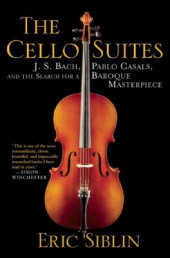
My latest side trip into the world of J. S. Bach is a paperback I picked up on a whim at our local indie bookshop: The Cello Suites by Canadian journalist Eric Siblin. I was previously unfamiliar with these suites except from guitar or lute transcriptions. Emusic has an excellent recording by Pierre Fournier on DGG Archiv for a decent price, so I availed myself of the opportunity. A wise move, because both book and music are excellent.
Siblin first encountered the cello suites at a recital selected by chance during the unwinding of a pop music critic stint at the Montreal Gazette. The program notes mentioned that no original manuscript of the suites has been located, and Siblin's journalistic interest was piqued. Nine years later, Siblin published his book, a parallel biography of Bach and Pablo Casals, the cellist who introduced the suites to the world. Bach wrote six cello suites, so Siblin divided his book into six parts, one for each suite. The suites each have six movements, following a standard sequence, starting with a Prelude, Allemande, Courante, Sarabande and concluding with a Gigue. The fifth movement varies between Minuet, Bourrée, or Gavotte. Siblin also subdivided each chapter into the suites' six movements, three for Bach, two for Casals, and reserving the ultimate gigue for the story of his quest.
Siblin shifts perspective in the Bach chapters so that the cello suites are never far from view even as his attention wanders over a wide range of topics, from biography of Bach and his descendants to reception history. Scholars place their genesis during Bach's tenure at Köthen, where he wrote much of his virtuoso keyboard and secular music. So Siblin has a chapter on the political forces that had caused excellent musicians to migrate to Köthen from Berlin, an example of a historical context that Siblin deploys throughout the book. A Near Eastern flourish in the prelude to the fourth suite leads to a digression on whether Bach might have ever heard Jewish music. Each chapter has an entertaining or illuminating anecdote, and together they give a multi-dimensional perspective on these suites.
The Casals chapters of necessity covered world history since Casals was an outspoken peace activist after the experience of WWII and the Spanish Civil War. He discovered the suites while he was foraging used sheet music stores in Barcelona when he was thirteen, and they became a lifelong trademark work. He made his first recording of the suites in 1936 while in exile to England, when the Battle of Madrid was raging. After the war, he refused to play in countries that supported, or even recognized, Franco, including the United States. He broke his vow only in 1958, when he performed in Manhattan as part of a United Nations concert, alarmed by the threat of nuclear war.
The personal reflections in the gigue chapters gave the book a depth of character that went beyond the biographies (and in Bach's case, informed speculation) of the two musical giants. Siblin learned a prelude on guitar, joined a community choir to sing a cantata, and even took a couple of cello lessons, all to get a deeper appreciation for Bach's music. His drive, coupled with the dual biographies, propelled the book forward, made me eager to read another chapter. Siblin's background in journalism informed his writing and made the book easier to read. Between his writing style and the short chapters, The Cello Suites is an entertaining read that I could read late at night when a scholarly book would have required too much concentration.
Wednesday, November 14, 2007
Linear music explained
 Karol Berger's book Bach's Cycle, Mozart's Arrow sets as its task the origins of musical modernity, specifically from the perspective of musical time. Berger carefully distinguishes modernity from modern music, where modernity is a fissure in a continuous historical lineage, generally located around the Industrial Revolution (with the French and American revolutions as the political counterparts). In pre-modern times, time was viewed as a cycle (e.g., of the sun and the seasons). By the end of the 18th century, time was viewed as progressive, a linear history moving from the past toward the future. Berger chooses Bach and Mozart as musical illustrations of these two perspectives, and Augustine and Jean-Jacques Rousseau for philosophical background.
 His chapters on Bach deal primarily with the St. Matthew Passion (which it has been a pleasure to hear again), with a short interlude on the first fugue from the WTC. The most illuminating section on Bach was on the fugue, which points out that the events in the fugue do not depend on one another in any meaningful way. Given the subject of a fugue, a certain number of "demonstrations" of the way the subject(s) may be harmonized and combined, each demonstration being independent of all the others. The demonstrations are essentially in an unordered set. Bach of course does combine them in a meaningful way according to a tonal plan, but in Berger's estimation, this combination comes later, and is of lesser importance than the demonstrations themselves.
I was much less moved by his discussion of the Passion, where he shows how Bach musically represents the Christian belief that our finite human time is enmeshed in the infinite time of God. While I don't doubt that this was indeed Bach's intent, the Christian story was considerably more real in Bach's time than it is in ours, where it has become more metaphorical (this is part of the transition to modernity that is the overall subject of the book). I don't believe one needs to be a devout Christian, versed in the arcane details of 18th century theology, to appreciate this magnificant work.
Undeniably, by the time of the Viennese classics, a listener was certainly expected to remember various events that occurred in the course of a piece. The classic sonata form, with two themes, a development and a recapitulation, all on a fairly standard tonal plan, makes little sense without some kind of short term memory to understand the structure of the piece. Berger demonstrates musical linearity with detailed examples from Mozart and Beethoven, but in both cases already showing how the conventions of the sonata form become expectations to be subverted.
A long interlude in the center of the book describes in some detail the philosophical changes that underpin Berger's arguments. Both the theological arguments behind the eternal time that precedes and follows the insignificant human time scale, as well as a summary of Rousseau's philosophical positions on our rational self-determination, are presented in some detail. Berger's intent is to show the philosophical changes that were current during the late 18th century, and which informed both the composers and listeners. If the arguments seem a bit esoteric and irrelevant today, an awareness certainly can inform contemporary interpretations of the music.
Granted, the classical concert repertoire is often too heavily invested in the Viennese classics that form the primary focus of this work. But when Berger says that "the Viennese classics have shaped our musical expectations and values to such an extent that we expect these values to inform any music we encounter," well, I'm sorry, but Berger needs to get out more. Discontinuity and various kinds of nonlinearity have been part of classical music since Schoenberg and Stravinsky — are there corresponding changes in our views on time? What perspective change do we need to appreciate a mobile form work like Cage's Atlas Eclipticalis, where the linearity is subverted from one performance to the next? Unfortunately, Berger's steadfast refusal to consider modern music (as opposed to modernity in general) makes the book somewhat less interesting to the general reader.
Wednesday, July 25, 2007
Orchestrating The Art of Fugue
Periodically I come back to Bach's late work, The Art of Fugue, through a new recording, which almost inevitably means a different orchestration of the work. The first edition, published shortly after Bach's death, was printed in an open score, with each voice on its own staff (contrasting with keyboard music, where multiple voices are printed on two staffs, one for each hand). Instrumentation was unspecified, but since most of the work is playable on a single keyboard, several great Bach interpreters have recorded it. I had Charles Rosen's piano recording on vinyl back in the day, and Glenn Gould recorded it on a pipe organ. The Emerson String Quartet released an excellent version of it a few years ago, and I've seen recordings for brass and sax ensembles, guitars, and various period ensembles.
Somewhere in my readings on the work, I read about an orchestral performance in Germany in 1928. I can no longer find the reference, but I have always pictured The Art of Fugue performed by an orchestra if not the size of Gustav Mahler's or Richard Strauss, would at least be capable of providing the many variations in color as Mahler and Strauss. I imagine having small instrumental groups within the orchestra play different pieces, using the different timbres to provide connections across the whole work.
 For a while I've had the set from Neville Marriner and soloists from the Academy of St. Martin in the Fields, where he worked with a string quintet, three winds, and two keyboardists. There's a little too many solo harpsichord pieces for my taste, but Neville's orchestration (which he prepared with Andrew Davis, who also played keyboard) for the ensembles were very nicely done. Recently I added a recording from 1965 by the Stuttgart Chamber Orchestra under the direction of Karl Münchinger. I read a review that said it was "unabashedly romantic", so I thought, why not. It is indeed beautiful, but it's mostly for a string orchestra, at least as far as I can tell. The liner notes talk about the work, but not about the orchestration of this particular version. I couldn't hear any winds at all until the canons, more than half way through, and even then, the winds are only used on a quarter of the pieces or fewer. Still not what I had in mind, but I'm glad I picked it up.
Since the instrumentation was unspecified, John Cage cited The Art of Fugue as an early example of indeterminate music. Certainly the lack of specificity has probably given us more different versions of this than of any other work, by Bach or anyone else. But I have to keep waiting for the kind of orchestral transcriptions have been done for Bach's big organ works. Some of Stokowski's big orchestrations, or Schoenberg's monumental orchestration of the St. Anne Prelude and Fugue, or even Webern's absolutely masterful and delicate orchestration of the Ricercar from The Musical Offering, are more what I have in mind. Webern used soloists from each section of the orchestra, doubling only the violins, and passed the melodic voices around from instrument to instrument. Only in the last few measures do all the instruments play at once. Schoenberg, on the other hand, used a huge orchestra, including a fairly sizable percussion section. But such an orchestration of so large a piece is impractical, at least until someone comes along with a library of orchestral samples and a lot of time on their hands….
Somewhere in my readings on the work, I read about an orchestral performance in Germany in 1928. I can no longer find the reference, but I have always pictured The Art of Fugue performed by an orchestra if not the size of Gustav Mahler's or Richard Strauss, would at least be capable of providing the many variations in color as Mahler and Strauss. I imagine having small instrumental groups within the orchestra play different pieces, using the different timbres to provide connections across the whole work.
 For a while I've had the set from Neville Marriner and soloists from the Academy of St. Martin in the Fields, where he worked with a string quintet, three winds, and two keyboardists. There's a little too many solo harpsichord pieces for my taste, but Neville's orchestration (which he prepared with Andrew Davis, who also played keyboard) for the ensembles were very nicely done. Recently I added a recording from 1965 by the Stuttgart Chamber Orchestra under the direction of Karl Münchinger. I read a review that said it was "unabashedly romantic", so I thought, why not. It is indeed beautiful, but it's mostly for a string orchestra, at least as far as I can tell. The liner notes talk about the work, but not about the orchestration of this particular version. I couldn't hear any winds at all until the canons, more than half way through, and even then, the winds are only used on a quarter of the pieces or fewer. Still not what I had in mind, but I'm glad I picked it up.
 Since the instrumentation was unspecified, John Cage cited The Art of Fugue as an early example of indeterminate music. Certainly the lack of specificity has probably given us more different versions of this than of any other work, by Bach or anyone else. But I have to keep waiting for the kind of orchestral transcriptions have been done for Bach's big organ works. Some of Stokowski's big orchestrations, or Schoenberg's monumental orchestration of the St. Anne Prelude and Fugue, or even Webern's absolutely masterful and delicate orchestration of the Ricercar from The Musical Offering, are more what I have in mind. Webern used soloists from each section of the orchestra, doubling only the violins, and passed the melodic voices around from instrument to instrument. Only in the last few measures do all the instruments play at once. Schoenberg, on the other hand, used a huge orchestra, including a fairly sizable percussion section. But such an orchestration of so large a piece is impractical, at least until someone comes along with a library of orchestral samples and a lot of time on their hands….
Tuesday, August 12, 2008
The concept of a musical work
An anonymous comment from my post on open forms a while back referenced Goehr for further thought about the specificity of scores and musical works. More recently, Greg Sandow got more specific, recommending Lydia Goehr's book The Imaginary Museum of Musical Works in his series of posts about classical and pop reviews. Talking about musical works seems such an ingrained part of our vocabulary, but it is refreshing and a bit bracing to read a discussion of what the phrase really means. I've always thought about musical works in the same category as Justice Potter Stewart's famous phrase about pornography — I know it when I see it. Naturally a precise definition is very slippery to grasp, and Goehr's book is an excellent articulation of all of the subtleties and tensions inherent in the concept or definition of a musical work.
Since Goehr is primarily a philosopher (although she's also the daughter of British composer Alexander Goehr, so she has sufficient musical background for the topic), she discusses in some detail the definitional aspects of a musical work. Her central claim is that a musical work isn't an object that can have a fixed definition, but a concept with both original and derivative uses, all of which are continuously emerging. The work concept functions as an ideal, something that lives out there as a limit but is rarely if ever attained in practice.
The biggest virtue of Goehr's philosophical treatise is that it places the work concept into a historical setting, starting from a time when the concept was not in place and showing the reasons why composers and musicians began to use it. It really comes as no surprise to find that the work concept emerged around 1800 as part of the romantic movement, and was part of an effort on the part of musicians to gain more economic autonomy for themselves. Bach, and to some extent even Mozart and Haydn, were employees, producing functional music on demand (for example, Bach's cantatas were all written for specific Sunday services). There was little consideration that a work had any particular structural or artistic integrity as a whole, so Bach was able to reuse any and all of his material as the occasion demanded, as well as borrow anything that might be useful from other composers (which is why there are so many works of uncertain authorship, in addition to pieces on acknowledged themes from other composers). Like so much else in the classical music world, Beethoven is the signpost for the changes, a convergence of theoretical and practical concerns around 1800 that set the eternal image of the creative genius who passes on his work, which will survive intact despite the vagaries of specific performances.
But, like so much else in the classical music world, at Beethoven we are stuck. Goehr spends some time discussing recent challenges to the work concept, both from inside and outside the classical music establishment. Cage and Stockhausen are mentioned, briefly, in their roles as theoreticians. But nobody has found a different way to talk about music, so we get the work concept when we discuss improv, pop, and world artists, despite vast differences in historical and cultural background. The romantic ideals have taken over the concert stage, so we get the incongruous spectacle of African drummers recreating indigenous dances for motionless listeners in a darkened auditorium. The issues of artistic autonomy and legitimacy that drove the romantic ideology in 1800 are still with us today. It was sobering to consider that musicians two centuries ago had to persuade the civil powers of their worth, even as music sought to free itself from the spectre of usefulness.
Since Goehr is primarily a philosopher (although she's also the daughter of British composer Alexander Goehr, so she has sufficient musical background for the topic), she discusses in some detail the definitional aspects of a musical work. Her central claim is that a musical work isn't an object that can have a fixed definition, but a concept with both original and derivative uses, all of which are continuously emerging. The work concept functions as an ideal, something that lives out there as a limit but is rarely if ever attained in practice.
The biggest virtue of Goehr's philosophical treatise is that it places the work concept into a historical setting, starting from a time when the concept was not in place and showing the reasons why composers and musicians began to use it. It really comes as no surprise to find that the work concept emerged around 1800 as part of the romantic movement, and was part of an effort on the part of musicians to gain more economic autonomy for themselves. Bach, and to some extent even Mozart and Haydn, were employees, producing functional music on demand (for example, Bach's cantatas were all written for specific Sunday services). There was little consideration that a work had any particular structural or artistic integrity as a whole, so Bach was able to reuse any and all of his material as the occasion demanded, as well as borrow anything that might be useful from other composers (which is why there are so many works of uncertain authorship, in addition to pieces on acknowledged themes from other composers). Like so much else in the classical music world, Beethoven is the signpost for the changes, a convergence of theoretical and practical concerns around 1800 that set the eternal image of the creative genius who passes on his work, which will survive intact despite the vagaries of specific performances.
But, like so much else in the classical music world, at Beethoven we are stuck. Goehr spends some time discussing recent challenges to the work concept, both from inside and outside the classical music establishment. Cage and Stockhausen are mentioned, briefly, in their roles as theoreticians. But nobody has found a different way to talk about music, so we get the work concept when we discuss improv, pop, and world artists, despite vast differences in historical and cultural background. The romantic ideals have taken over the concert stage, so we get the incongruous spectacle of African drummers recreating indigenous dances for motionless listeners in a darkened auditorium. The issues of artistic autonomy and legitimacy that drove the romantic ideology in 1800 are still with us today. It was sobering to consider that musicians two centuries ago had to persuade the civil powers of their worth, even as music sought to free itself from the spectre of usefulness.
Monday, March 26, 2007
Piano technicians—fiction
 Occasionally an interesting novel about music crosses my path, and most recently I finished The Piano Tuner, a first novel by Daniel Mason. The protagonist is Edgar Drake, specialist in Erard pianos, who is summoned by the British War Office to tune an Erard belonging to Anthony Carroll, an unorthodox officer deep in the jungles of Burma. Although the novel is set in the late 1880s, at the conclusion of the Third Anglo-Burmese War, when the British Empire was finally consolidated and the current boundaries of Burma (now Myanmar) were set, the main characters and settings are completely fictional. Carroll has set up shop in eastern Burma and has established friendly relations with the local tribal leaders, and some time before the beginning of the novel, has requested and received an Erard piano. However, the jungle humidity and the difficulties of transport have taken their toll on the piano, so Carroll has requested a tuner. The War Office selects Drake, and Drake agrees to the trip.
 Drake is a sensitive individual and considerably more aware of his surroundings than most of the military men with whom he shares his trip. With his background as a piano tuner, he is also acutely sensitive to the sounds of the trip. He meets the Man with One Story, who travels the Red Sea seeking the music which he heard once, and from which he awoke completely deaf. He wanders the streets of Mandalay and finds puppet theaters, complete with otherworldly songs. But Drake identifies most closely with Bach's music, in particular the Well-Tempered Clavier, which he learned as an apprentice, and whose great melodies of worship and faith "are named after the act of tuning a piano." Bach's music contains a world of beauty found in order and the laws of counterpoint. This contrasts not only with the disordered beauty of the unexplored Burmese jungle in which Drake finds himself, but with the hidden and unnamed song that lies inside each piano. Another lesson for the apprentice: we must tune pianos so that something as mundane as muscles and tendons and keys and wire and wood can become song. In the jungle, it seems like the instrument eventually follows its own path and finds its own song, despite Drake's best intentions.
In the same way that melodies recall other melodies, The Piano Tuner reminds me of many other stories. For a long part of the novel, Carroll is like Colonel Kurtz from The Heart of Darkness and Apocalypse Now. The Man with One Story recalls another traveler, Odysseus, in his encounter with the Sirens (Carroll explicitly reminds Drake of the Lotus-Eaters, another tale from the Odyssey). Without revealing too much of the ending, Drake succeeds in finding and tuning the piano, and even manages to cross over from tuner to finding his own music and becoming a performer, playing his beloved Bach to tribal royalty.
Mason trained in biology and spent a year in the region studying malaria, so he brings considerable local color to the novel. Most of the reviews emphasize the locale more than the music, but it was interesting to me because of the musical connection, how would a man steeped in music change the basic heart-of-darkness plot? And besides, even though the Library of Congress has a heading for fiction about piano technicians, how many novels like this are there, really?
Tuesday, May 22, 2007
From the Seven Days
Jeremy Denk is celebrating a birthday with seven days of blogging on the Allemande from Bach's fourth partita. It's an amazing tour de force, and opened my eyes to new ways of listening to Bach (and I still find myself compelled to start every day with an hour of his preludes and fugues). Start with day one and keep hitting the Newer Post button at the bottom to read the whole thing.
Monday, February 16, 2009
Static literature

Many years ago, I picked up a couple of books by Austrian novelist Thomas Bernhard, a poet of despair whose bleak outlook is second only to Samuel Beckett. Over the past few months, I've pulled out his memoirs of his early years, Gathering Evidence, reading each of its five sections as an antidote to both more whimsical crime novels or more focused music theory works. Although Bernhard's prose doesn't have the same experimental syntax as Beckett, with complete sentences and correct grammar, his works have no breaks for paragraphs or chapters, a long unbroken ramble over a few obsessive topics. A lot like drone music.
Bernhard wrote often about music, and, according to Gathering Evidence, he was a reasonably good bass with consideration at one time of becoming a professional singer. One of his novels, The Loser, is about a budding piano virtuoso whose life and career were ruined when he heard Glenn Gould play the Goldberg Variations, seeing therein a level of perfection to which he could never hope to attain. In another, Concrete, the protagonist is a musicologist struggling futilely to write a book on Felix Mendelssohn. So I don't consider musical comparisons to be entirely fanciful.
Gathering Evidence was originally published as five separate volumes, covering only the first nineteen years of his life. Each volume is bitter against his family and Austrian society around WWII (the book covers the years 1935-1950 or so), with plenty of bile for the medical community as well, as he spent his teenage years in a sanatarium for lung disease, misdiagnosed and surrounded by ineptitude of all kinds (plus ça change...). His ongoing attempts to gather evidence about his existence, despite fruitless efforts to learn from his family about his origins, leads to a rigorous self-examination of his motives and prospects. More successful than his eponymous loser, Bernhard elevates his rancor into an uncompromising indictment, as we know from Bernhard's biography as a successful, if controversial, writer.
Sometimes I look for parallels between the creative arts. Certainly several musicians have drawn parallels between static music and Mark Rothko's paintings, and I also see many of the same qualities in Bernhard's prose and drone music. An essentially static art, with small variations within the wide stream, Bernhard's drones start and stop in the middle of nowhere and never move very far from their origins. His obsession with relatively few themes, setting them in motion one against another, compares with how drone artists construct their work in layers, with different elements given local prominence. Even in his memoirs, he was really only able to change scenes by writing a new book altogether — the five books were only collected in translation, and were only available separately in German. In the past, I compared Bernhard to Bach, not only for the elliptical references to Gould, but because his themes are so intricately intertwined. But Bach's tonal harmonies and devotion to God are very different from Bernhard's shades of gray, and it's very difficult now to find in Bernhard any shades of reverence or emotional fulfillment.
Where drone music doesn't follow Bernhard, of course, is the bitterness and anger. Drone music is seldom so raw; even in its most low-fi examples, it produces a blur, a haze where clear distinctions are washed out, sanded away. Other music expresses anger and rage very well, but at the moment current events produce enough stress. I calmly accept drone music as a refuge, and turn to Beckett and Bernhard for the bracing purity of their indignation.
The photograph of Thomas Bernhard is copyrighted by Erika Schmied, and is taken from one of the German-language Bernhard memorial sites.
Monday, August 16, 2010
Bach Transcriptions at the BBC Proms
I've written before about the joys of Bach transcriptions, and one of the BBC Proms concerts this year programmed a delightful set of Andrew Litton conducting the Royal Philharmonic Orchestra, streaming for a few more days here. In addition to ever popular works like Respighi's version of the Passacaglia and Fugue, the program includes a suite by William Walton and new commissions from younger composers Alissa Firsova and Tarik O'Regan.
Tuesday, December 30, 2008
2008 highlights
It's that time of year again, where we enumerate the year's highlights. Here's my top 20, in chronological order of acquisition, so there is no guarantee that they were issued this year. The Calefax Reed Quintet's version of Bach's Art of Fugue was released in 2000, but it has quickly become my favorite rendition of that work, well worth tracking down. I posted about a couple of these albums during the course of the year, but I didn't get to review as many CDs here as I would have liked. I have also made no attempt to delineate by genre. My reissue of the year is unquestionably the Bernard Parmegiani box set.
- Katatonia, The Great Cold Distance (Peaceville)
- Gavin Bryars & Philip Jeck, The Sinking of the Titanic (Touch)
- Huntsville, For the Middle Class (Rune Grammophon)
- Earth, The Bees Made Honey in the Lion's Skull (Southern Lord)
- Mark Wastell, Amoungst English Men (Absinthe)
- Werner Durand, Remnants from Paradise (Absurd)
- Brendan Murray, Commonwealth (23five)
- The Necks, Mosquito/See Through (ReR)
- Erik Enocksson, Farval Falkenberg (Kning)
- Morton Feldman, The Viola in my Life (ECM)
- Frank Bretschneider, Rhythm (Raster-Noton)
- Mathieu Ruhlmann & Celer, Mesoscaphe (Spekk)
- Darshan Ambient, From Pale Hands to Weary Skies (Lotusspike)
- Janek Schaefer, Extended Play (Line)
- Kalte, The Lanthanide Series (stasisfield.com)
- Stray Ghost, Losthilde (Highpoint Lowlife)
- Parts & Labor, Receivers (Jagjaguwar)
- erikm & Thomas Lehn, Les Protorythmiques (Room40)
- Jacaszek, Treny (Miasmah)
- J. S. Bach, Art of Fugue (Calefax Reed Quintet) (MDG)
Friday, October 31, 2008
Préludes tous seuls
Along with Daniel Wolf and Phil Ford, I've found it somewhat difficult to concentrate what with all the election sludge in the air. Arizona permits early voting, so we've already cast our ballets. I no longer need pay any attention to the proceedings (at least Tuesday evening).
So in the meantime, I have found an alternative listening to Bach's Well-Tempered Clavier that I would never have occurred to me before iTunes playlists: only the preludes, and play them in Chopin order (up the circle of fifths instead of chromatic ascent). Everything sounds completely different, as varied a program as one might desire. As far as I know, this hasn't been programmed anywhere, but it's no more unorthodox than the current sacred practice of playing the whole set of preludes and fugues in order. Bach intended them as teaching pieces, after all, not for performance.
Saturday, May 12, 2007
A British orchestral program
As the fine arts season in Tucson winds up (and as the snowbirds go back east), the Tucson Symphony Orchestra played their last regular classical concert this weekend. Guest conductor David Lockington led a program of British composers, playing three works, none of which I had ever heard before. Stepping outside the standard repertoire is a refreshing approach, which I find much more enjoyable than the often-repeated Beethoven, Mozart and Brahms.
The concert opened with a contemporary work by Philip Sawyers, a concert overture entitled The Gale of Life. Sawyers was present at the concert and gave a few opening remarks, along with a somewhat superfluous introduction by Mr. Lockington. The piece had some gorgeous moments, especially during a reflective part in the middle for strings and glockenspiel, and an exuberant finale. Although Lockington mentioned an influence from the second Viennese school, there was nothing overtly serial about the piece, or at least it wasn't as spiky as the influence suggested.
Second on the program was Ralph Vaughan Williams' Fourth Symphony in F minor. I have only a passing familiarity with Vaughan Williams, having inherited some recordings of the second, sixth and ninth symphonies, and of course the Tallis fantasy. In retrospect, this symphony seems characteristic of the 1930s when it was written, with its powerful and dark opening chords. But the end of the first movement, transitioning to the second, is slow and peaceful. The second movement is a big duet between the winds and the strings, with each section taking a turn in developing its contrapuntal themes. The flute and oboe play the main theme over pizzicato strings, followed by a similar play between the violas and violins. The scherzo brings together many of the themes that have been presented so far, and is followed immediately by the finale, where the primary motif is used for a big brass fugue, alternating with a oom-pah brass band section and sections in a strange, jerky rhythm. The fugue subject is built from the same material as the preceding sections, but in its full glory here is recogizable as the B-A-C-H melody, using Bach's name as musical material (and using the German spelling for B-flat = 'H'). This is a wonderful, big symphony, and a real treat to hear live.
The second half of the program was Edward Elgar's violin concerto, played by the TSO's concertmaster, Steven Moeckel. A beautiful, late romantic work, the concerto was played with great balance from the orchestra, and Moeckel performed the demanding solo part with great passion. The cadenza was a bit unusual in that it was accompanied by quietly strumming strings, which created an ethereal effect. All three pieces on the program were lovely and well worth hearing again. Congratulations to the Tucson Symphony for an unusual and delightful program.
The concert opened with a contemporary work by Philip Sawyers, a concert overture entitled The Gale of Life. Sawyers was present at the concert and gave a few opening remarks, along with a somewhat superfluous introduction by Mr. Lockington. The piece had some gorgeous moments, especially during a reflective part in the middle for strings and glockenspiel, and an exuberant finale. Although Lockington mentioned an influence from the second Viennese school, there was nothing overtly serial about the piece, or at least it wasn't as spiky as the influence suggested.
Second on the program was Ralph Vaughan Williams' Fourth Symphony in F minor. I have only a passing familiarity with Vaughan Williams, having inherited some recordings of the second, sixth and ninth symphonies, and of course the Tallis fantasy. In retrospect, this symphony seems characteristic of the 1930s when it was written, with its powerful and dark opening chords. But the end of the first movement, transitioning to the second, is slow and peaceful. The second movement is a big duet between the winds and the strings, with each section taking a turn in developing its contrapuntal themes. The flute and oboe play the main theme over pizzicato strings, followed by a similar play between the violas and violins. The scherzo brings together many of the themes that have been presented so far, and is followed immediately by the finale, where the primary motif is used for a big brass fugue, alternating with a oom-pah brass band section and sections in a strange, jerky rhythm. The fugue subject is built from the same material as the preceding sections, but in its full glory here is recogizable as the B-A-C-H melody, using Bach's name as musical material (and using the German spelling for B-flat = 'H'). This is a wonderful, big symphony, and a real treat to hear live.
The second half of the program was Edward Elgar's violin concerto, played by the TSO's concertmaster, Steven Moeckel. A beautiful, late romantic work, the concerto was played with great balance from the orchestra, and Moeckel performed the demanding solo part with great passion. The cadenza was a bit unusual in that it was accompanied by quietly strumming strings, which created an ethereal effect. All three pieces on the program were lovely and well worth hearing again. Congratulations to the Tucson Symphony for an unusual and delightful program.
Tuesday, July 24, 2007
The Perils of Organization
Periodically I will get an organizational bug and think about sorting my books again. We had them all arranged back in Dayton, separated into fiction, non-fiction, and poetry. When we got here, they went on the shelves with no thought towards ordering, only towards a house free of boxes. Little by little, some order has crept in, sort of a reverse entropy. First to get sorted was the music books — not completely ordered yet, but at least all the books by or about Cage and Bach are together on the same shelf. So today I tried separating fiction from non-fiction. It went all right for a little while, but then I found a shelf whose connections were so delicate, so inimitable, and so serendipitous that I immediately returned to my computer, preferring to idle away time in games and other trivial pursuits rather than question the wisdom of the universe. National Book Award winning travel writer Peter Hessler, philosopher Theodor Adorno, Nobel Prize winning novelist Kenzaburo Oe, and the indescribable William Burroughs shall continue their cohabitation. At least until next time…
Monday, August 27, 2007
How to play inside the piano
One of my recently discovered joys-of-Netflix is that they carry new music DVDs released on the Mode label. Mode has long been a premiere souce for new music, with an early emphasis on the New York school composers, and now including many first recordings from across the US as well as Europe and Asia. They have also been one of the first new music labels to release material on DVD, including opera, concerts, and short films. A while back I rented a DVD of four movies by or about John Cage, and currently we're watching Margaret Leng Tan playing and discussing George Crumb's pathbreaking piano suites Makrokosmos, volumes 1 and 2.
 Crumb has a unique place in the history of post-WWII piano music. I remember when the Makrokosmos series was released on vinyl, and it was a very different perspective on contemporary music from both the Darmstadt and New York composers. I was very excited about Crumb's music, and bought the scores for Makrokosmos II and his earlier Five Pieces for Piano. Makrokosmos is a gorgeous and unique (and oft-reproduced) score. Both volumes are exquisitely drawn, with some of the pieces in non-standard layouts, such as the one on the DVD's cover, taken from Agnus Dei, the last piece in book two. He was the first to popularize, if not introduce, many extended techniques for playing inside the piano, including pizzicato, glass tumblers, sheets of paper, chains, playing the beams, etc. The techniques are related to Cage's prepared piano, but Cage generally modified the piano's timbre by weaving objects between the strings of a single note (such as coins, screws, bolts, bamboo shoots, and pencil erasers), which then stays fixed for the duration of the piece. Crumb's preparations are more dynamic and often require a different sort of performance technique. Crumb's piano works are a sensuous and delicate music that never sounds like anyone else.
Leng Tan is, by her own admission, a virtuoso of extended techniques on the piano. She has previously recorded Crumb's Five Pieces as well as a number of Cage prepared and toy piano pieces. Although here she's in concert dress, the performance seems to have been filmed in a bare backstage room, with breaks between the pieces (which you can see from the presence or absence of scores and various preparations) and no audience. The film's director, Evans Chan, indulges in some occasional trickery, with odd lighting and color effects. But with Makrokosmos, the pianist is always moving, whether to pluck the strings on the inside of the piano or using the various props. So the camera is also always moving, following Leng Tan closely, using frequent double exposures to show her hands and her body simultaneously. The film is a very effective view of Leng Tan's excellent and dynamic performance.
The DVD also includes a 45-minute conversation between Leng Tan, Crumb, and Don Gillespie from Crumb's publisher, Edition Peters. Although it seems pretty ad hoc sometimes, there are some real nuggets in here. Leng Tan provides some context for the extended techniques, comparing the canonical three B's (Bach, Beethoven and Brahms) for classical composition with the three C's for extended piano techique (Henry Cowell, Cage and Crumb). She could have found one more C with Curtis Curtis-Smith, who developed the bowed piano with his 1973 piece Rhapsodies, but that's a minor quibble. There's also a fascinating anecdote about one of the pieces that quotes Chopin's Fantasie-Impromptu. Crumb had originally quoted a Rachmaninoff piece, but he had to re-compose a week before the premiere because they couldn't get the rights to the Rachmaninoff. And we thought sample theft was new to the digital era!
Crumb's piano music remains somewhat controversial, even now, thirty-five years after its first performance. Many pianists, teachers and technicians don't like playing on the inside of the piano, believing that the piano strings will become damaged because of the oils in the pianist's hands. But the pieces have a life of their own, and many improvisational pianist, such as Sophie Agnel and Andrea Neumann, use these techniques in their own work. Mode has done a great job with this DVD, capturing not only the music, but the visual performance as well.
Crumb has a unique place in the history of post-WWII piano music. I remember when the Makrokosmos series was released on vinyl, and it was a very different perspective on contemporary music from both the Darmstadt and New York composers. I was very excited about Crumb's music, and bought the scores for Makrokosmos II and his earlier Five Pieces for Piano. Makrokosmos is a gorgeous and unique (and oft-reproduced) score. Both volumes are exquisitely drawn, with some of the pieces in non-standard layouts, such as the one on the DVD's cover, taken from Agnus Dei, the last piece in book two. He was the first to popularize, if not introduce, many extended techniques for playing inside the piano, including pizzicato, glass tumblers, sheets of paper, chains, playing the beams, etc. The techniques are related to Cage's prepared piano, but Cage generally modified the piano's timbre by weaving objects between the strings of a single note (such as coins, screws, bolts, bamboo shoots, and pencil erasers), which then stays fixed for the duration of the piece. Crumb's preparations are more dynamic and often require a different sort of performance technique. Crumb's piano works are a sensuous and delicate music that never sounds like anyone else. Leng Tan is, by her own admission, a virtuoso of extended techniques on the piano. She has previously recorded Crumb's Five Pieces as well as a number of Cage prepared and toy piano pieces. Although here she's in concert dress, the performance seems to have been filmed in a bare backstage room, with breaks between the pieces (which you can see from the presence or absence of scores and various preparations) and no audience. The film's director, Evans Chan, indulges in some occasional trickery, with odd lighting and color effects. But with Makrokosmos, the pianist is always moving, whether to pluck the strings on the inside of the piano or using the various props. So the camera is also always moving, following Leng Tan closely, using frequent double exposures to show her hands and her body simultaneously. The film is a very effective view of Leng Tan's excellent and dynamic performance.
The DVD also includes a 45-minute conversation between Leng Tan, Crumb, and Don Gillespie from Crumb's publisher, Edition Peters. Although it seems pretty ad hoc sometimes, there are some real nuggets in here. Leng Tan provides some context for the extended techniques, comparing the canonical three B's (Bach, Beethoven and Brahms) for classical composition with the three C's for extended piano techique (Henry Cowell, Cage and Crumb). She could have found one more C with Curtis Curtis-Smith, who developed the bowed piano with his 1973 piece Rhapsodies, but that's a minor quibble. There's also a fascinating anecdote about one of the pieces that quotes Chopin's Fantasie-Impromptu. Crumb had originally quoted a Rachmaninoff piece, but he had to re-compose a week before the premiere because they couldn't get the rights to the Rachmaninoff. And we thought sample theft was new to the digital era!
Crumb's piano music remains somewhat controversial, even now, thirty-five years after its first performance. Many pianists, teachers and technicians don't like playing on the inside of the piano, believing that the piano strings will become damaged because of the oils in the pianist's hands. But the pieces have a life of their own, and many improvisational pianist, such as Sophie Agnel and Andrea Neumann, use these techniques in their own work. Mode has done a great job with this DVD, capturing not only the music, but the visual performance as well.
Saturday, March 3, 2007
So long, song
Scott Spiegelberg over at Musical Perceptions has a recent post on the longest tracks in his iTunes. His two longest are both from Bach's B Minor Mass, but my version (Gardiner's) splits out the choruses and arias into individual tracks, so nothing there is longer than ten minutes. And I have to confess, the majority of longest tracks in my iTunes remain unheard — as Scott also mentions, sometimes tracks are too long.
So the fourteen longest tracks on my iTunes are downloads for a long listening project that I've never actually had the courage to undertake: Leif Inge's 24-hour Beethoven symphony, Nine Beet Stretch. I've listened to the first track only, but the entire thing is still available for download at Inge's site. Most of them are too long to fit on a CD, coming in at 1:23:06.
Then, the next longest is Morton Feldman's Patterns in a Chromatic Field, from the Tzadik release. I've listened to this once, but I have lots of other large-scale Feldman recordings as well. (My most recent long Feldman, which I listened to this past week, was Marilyn Nonken's two-CD recording of Triadic Memories, which I followed in the score.) For a brief moment, this track was available on eMusic, but Tzadik has since removed from eMusic all tracks longer than a certain length, of which this would certainly be a prime candidate. It clocks in at 1:20:42, which is probably the limit of a CD.
Next, I keep sleep music on iTunes and my iPod, and there are a number of CD-length ambient pieces that I use for late-night listening. In this category, I have works by Austere, Steve Roach, Paul Vnuk, Rihmasto, Chris Meloche (I cheated here and joined all six CD tracks on Recurring Dreams of the Urban Myth when I imported the CD) and Tau Ceti, all of which top the 70-minute mark, and all of which have multiple hearings. These artists all use long durations to create quiet musical environments, and some of them have expressly created works for overnight performance and broadcast.
Finally, I have a number of downloads from the netlabel Webbed Hand Records, specifically in their Rain series. These works also attempt to create minimalistic soundscapes that would fill an entire CD, and I have six of them longer than 70 minutes. I would note that not all of the Rainscapes are suitable for sleeping, but they would certainly qualify for other ambient purposes. Some of them have ominous overtones that would introduce nightmares. All are freely available for downloads, and Webbed Hand is one of the more interesting netlabels that I've found. I'm listening to one of them now (Rain 3 by Djinnestan), and it's a peaceful combination of water, crickets, with some occasional drones fading in and out.
There is certainly a point where long tracks don't get heard as often. Other than the long sleep tracks, there are a lot of long songs in my iTunes that still have play counts of zero. I have some DJ mixes that I've downloaded that have sounded interesting at the time, but for whatever reason still remain unheard. I also have used iTunes to create backups for CD-R releases, but when I listen to the music, it's still through the CD-R rather than iTunes (artists in this category include William Basinski, Michael Prime, and a number of artists on the Mystery Sea CD-R label). I used to download podcasts, but stopped for essentially the same reason — other than sleeping, I don't have many occasions to listen to long musical works. Perhaps our next iTunes analysis exercise should be which tracks have the highest play counts …
So the fourteen longest tracks on my iTunes are downloads for a long listening project that I've never actually had the courage to undertake: Leif Inge's 24-hour Beethoven symphony, Nine Beet Stretch. I've listened to the first track only, but the entire thing is still available for download at Inge's site. Most of them are too long to fit on a CD, coming in at 1:23:06.
Then, the next longest is Morton Feldman's Patterns in a Chromatic Field, from the Tzadik release. I've listened to this once, but I have lots of other large-scale Feldman recordings as well. (My most recent long Feldman, which I listened to this past week, was Marilyn Nonken's two-CD recording of Triadic Memories, which I followed in the score.) For a brief moment, this track was available on eMusic, but Tzadik has since removed from eMusic all tracks longer than a certain length, of which this would certainly be a prime candidate. It clocks in at 1:20:42, which is probably the limit of a CD.
Next, I keep sleep music on iTunes and my iPod, and there are a number of CD-length ambient pieces that I use for late-night listening. In this category, I have works by Austere, Steve Roach, Paul Vnuk, Rihmasto, Chris Meloche (I cheated here and joined all six CD tracks on Recurring Dreams of the Urban Myth when I imported the CD) and Tau Ceti, all of which top the 70-minute mark, and all of which have multiple hearings. These artists all use long durations to create quiet musical environments, and some of them have expressly created works for overnight performance and broadcast.
Finally, I have a number of downloads from the netlabel Webbed Hand Records, specifically in their Rain series. These works also attempt to create minimalistic soundscapes that would fill an entire CD, and I have six of them longer than 70 minutes. I would note that not all of the Rainscapes are suitable for sleeping, but they would certainly qualify for other ambient purposes. Some of them have ominous overtones that would introduce nightmares. All are freely available for downloads, and Webbed Hand is one of the more interesting netlabels that I've found. I'm listening to one of them now (Rain 3 by Djinnestan), and it's a peaceful combination of water, crickets, with some occasional drones fading in and out.
There is certainly a point where long tracks don't get heard as often. Other than the long sleep tracks, there are a lot of long songs in my iTunes that still have play counts of zero. I have some DJ mixes that I've downloaded that have sounded interesting at the time, but for whatever reason still remain unheard. I also have used iTunes to create backups for CD-R releases, but when I listen to the music, it's still through the CD-R rather than iTunes (artists in this category include William Basinski, Michael Prime, and a number of artists on the Mystery Sea CD-R label). I used to download podcasts, but stopped for essentially the same reason — other than sleeping, I don't have many occasions to listen to long musical works. Perhaps our next iTunes analysis exercise should be which tracks have the highest play counts …
Saturday, June 28, 2008
SICPP, one week later
I've been home from SICPP for a week now, which is starting to be enough time to digest whatever I learned from the experience. I've had a desire to attend for several years, but the desire firmed into a goal when Drury last January announced that Kondo was the composer-in-residence. I learned a couple of pieces better than I ever had before, performed one in a master class and the other on a public stage (a first as a pianist, although I performed on guitar in my salad days). I worked directly with a composer of international stature, a bright spot on any resumé. But on the last day, during the final Iditarod concert, I took a dinner break at the half-way point, only to have the exhaustion of the week catch up to me. I thought about my 7am flight, asked myself whether I really wanted to stay up until after midnight, and returned to my hotel and crashed (Matthew Guerrieri caught the Iditarod's second half and reports on it here).
One of the consequences of SICPP's shift from solo piano to chamber music (a telling measure of its success in new music pedagogy) meant that I had more free time on my hands than most of the other students. Combined with a lack of my usual distractions (free wifi was nearly impossible to find, except at the coffee shop where I got a large dark roast every morning), I had time to reflect on my personal goals as a musician, and notice how different they are from my SICPP colleagues. Professional musicians work very hard, long hours, not always playing music they like, seldom having the luxury of adequate rehearsels. But even further, if I have taken to heart Cage's dictum of music to sober and quiet the mind, and if a lot of new music that I admire has this same goal, there was precious little time for the mind to stay quiet, or to look around for divine influences when it got there.
There have been a couple of articles around the blogosphere since my return that address this point as well. David Harrell points to emusic blogs and a recent Atlantic article to identify "content fatigue" as the feeling of being overwhelmed by too much new music to process. The effort to slow down and listen is a major reason why I started this blog. A lot of the new music at SICPP wore Morton Feldman influences on its sleeve — even the Kondo piece that I played was reminiscent of Feldman. But one of Feldman's characteristics is the total immersion required for his late works, which start at 30 minutes and, for works like his second string quartet or For Philip Guston, can last hours (and after four and a half hours at the SICPP Iditarod, I don't think I could sit through a performance of either one). One of the composition students, Marti Epstein, brought See, Even Night, a lovely Feldmanesque piece for clarinet, viola and piano, which was performed in the first half of the Iditarod. I would like to have wallowed in this piece, listening to the three instruments softly float around each other. But immersion is another luxury that professional musicians don't often get, because there is so much music to be played.
The inevitable downside is that my musical niche becomes smaller and smaller. Glenn at Coolfer and David Harrell have both commented recently on the long tail, pointing to the long-term unprofitability of niche music. Music I admire is released in editions of 500 or less, and this takes over a year to sell out. I still have over a dozen unopened CDs on my desk (although a number of them were acquired in Boston — what a treat to find a brick-and-mortar store that actually has music I'd want to hear!) because the collector want more bright shiny things, but the listener wants to take time and savor each individual work. So now that I'm back from Boston, I will settle once again into my niche, post some reviews on this blog (which I've sadly neglected during my work towards SICPP), and spend my piano time relearning some Bach, sight reading and improvising. I am in no hurry today.
One of the consequences of SICPP's shift from solo piano to chamber music (a telling measure of its success in new music pedagogy) meant that I had more free time on my hands than most of the other students. Combined with a lack of my usual distractions (free wifi was nearly impossible to find, except at the coffee shop where I got a large dark roast every morning), I had time to reflect on my personal goals as a musician, and notice how different they are from my SICPP colleagues. Professional musicians work very hard, long hours, not always playing music they like, seldom having the luxury of adequate rehearsels. But even further, if I have taken to heart Cage's dictum of music to sober and quiet the mind, and if a lot of new music that I admire has this same goal, there was precious little time for the mind to stay quiet, or to look around for divine influences when it got there.
There have been a couple of articles around the blogosphere since my return that address this point as well. David Harrell points to emusic blogs and a recent Atlantic article to identify "content fatigue" as the feeling of being overwhelmed by too much new music to process. The effort to slow down and listen is a major reason why I started this blog. A lot of the new music at SICPP wore Morton Feldman influences on its sleeve — even the Kondo piece that I played was reminiscent of Feldman. But one of Feldman's characteristics is the total immersion required for his late works, which start at 30 minutes and, for works like his second string quartet or For Philip Guston, can last hours (and after four and a half hours at the SICPP Iditarod, I don't think I could sit through a performance of either one). One of the composition students, Marti Epstein, brought See, Even Night, a lovely Feldmanesque piece for clarinet, viola and piano, which was performed in the first half of the Iditarod. I would like to have wallowed in this piece, listening to the three instruments softly float around each other. But immersion is another luxury that professional musicians don't often get, because there is so much music to be played.
The inevitable downside is that my musical niche becomes smaller and smaller. Glenn at Coolfer and David Harrell have both commented recently on the long tail, pointing to the long-term unprofitability of niche music. Music I admire is released in editions of 500 or less, and this takes over a year to sell out. I still have over a dozen unopened CDs on my desk (although a number of them were acquired in Boston — what a treat to find a brick-and-mortar store that actually has music I'd want to hear!) because the collector want more bright shiny things, but the listener wants to take time and savor each individual work. So now that I'm back from Boston, I will settle once again into my niche, post some reviews on this blog (which I've sadly neglected during my work towards SICPP), and spend my piano time relearning some Bach, sight reading and improvising. I am in no hurry today.
Tuesday, July 17, 2007
Chamber music in a Tucson summer
A few weeks ago, I mentioned that the fine arts season here in Tucson had dried up for the summer. But last Sunday, even without the missing snowbirds and despite the heat, Tucson Symphony Orchestra concert master Steven Moeckel led a piano quintet under the auspices of the St. Andrews Bach Society. The quintet included Moeckel's sister Laura on viola together with siblings Ellen and Robert Chamberlain on second violin and cello. Paula Fan, Moeckel's regular accompanist and Professor at the University of Arizona, played piano. The group played Elgar's Piano Quintet in a minor (op. 84) and Brahms' Piano Quintet in f minor (op. 34). I enjoyed both pieces very much, and the playing throughout seemed more than capable (even though Robert Chamberlain is currently a master's student). The concert was packed, and the audience was enthusiastic. However, the performance was marred by the venue, Grace St. Paul's Episcopal Church. The church is beautiful, with broad wooden beams and a number of lovely stained glass windows done in a traditional style, but the benches were rock hard and the acoustics were terrible. Episcopals spend a lot of time changing position, sometimes kneeling (they are generally the only churches I've found that still have kneelers), and sometimes standing. Churches where the congregation sits all the time seem to have more comfortable seats. As for the sound, perhaps because I was sitting on the far left side, or perhaps because the air conditioning system was too loud, the instruments all blurred together. At times I could see the instrumentalists playing pizzicato but heard nothing. The concert was recorded for a local TV/Radio station, so hopefully their microphone placement had a better sound.
The overall good news is that Tucson seems to be a chamber music town. In southern Ohio, there were a number of venues that had regular solo piano concerts, but chamber music was hard to find. This concert had excellent players and interesting pieces, so I look forward to other groups in the area.
The overall good news is that Tucson seems to be a chamber music town. In southern Ohio, there were a number of venues that had regular solo piano concerts, but chamber music was hard to find. This concert had excellent players and interesting pieces, so I look forward to other groups in the area.
Friday, January 1, 2010
Adios 2009!
It's that time again, to look back and reflect on the music and events from the past twelve months. Staggeringly, I acquired almost twice as much new music this year compared to 2008, largely through the discovery of web sites and blogs that make available bootleg radio broadcasts. This had the unfortunate side effect of reducing the number of netlabel releases that I was able to absorb, because there are only so many hours in the day. However, it also had the impact of increasing the amount of contemporary classical music I heard, since most of the boots were otherwise unrecorded new music. A somewhat depressing consequence is that I looked over the list, and several times asked myself, what's that? I don't remember anything about that one!
Another shift in my listening habits, especially in the last quarter of the year, is that I've started listening more to CDs than downloads. I've been a staunch advocate for downloads for years, and even got into a bit of a flamefest on the ambient mailing list on the subject. And yet, it bothers me that I listen so much to downloaded music in preference to recordings that cost considerably more than the downloads, and which sit largely forgotten on the shelf. This change in attitude is perhaps a response to emusic's two-pronged price increase, not only charging 40% more per download, but forcing the use of twelve credits for an album if the album has any tracks longer than ten minutes. Even though I've kept my subscription, and even though I recognize that paying a quarter for an album is unfair, the luster has fallen off the pumpkin with this service.
Albums that made an impression this year (album links to reviews I wrote) include:
I eagerly look forward to the new music of 2010, and wish everyone a happy and safe new year.
Another shift in my listening habits, especially in the last quarter of the year, is that I've started listening more to CDs than downloads. I've been a staunch advocate for downloads for years, and even got into a bit of a flamefest on the ambient mailing list on the subject. And yet, it bothers me that I listen so much to downloaded music in preference to recordings that cost considerably more than the downloads, and which sit largely forgotten on the shelf. This change in attitude is perhaps a response to emusic's two-pronged price increase, not only charging 40% more per download, but forcing the use of twelve credits for an album if the album has any tracks longer than ten minutes. Even though I've kept my subscription, and even though I recognize that paying a quarter for an album is unfair, the luster has fallen off the pumpkin with this service.
Albums that made an impression this year (album links to reviews I wrote) include:
- Sleepy Town Manufacture and Unit 21 — No Traces (Infraction)
- Library Tapes — Fragment (Kning)
- Colin Andrew Sheffield — Signatures (Invisible Birds)
- Steinbrüchel — Sustain (Koyuki)
- Saito Koji — Time/Line (Resting Bell), freely available
- Haptic — The Medium (FSS)
- Gregg Kowalsky — Tape Chants (Kranky)
- Mara's Torment — Tactile (Ping Things), freely available
- Richard Garet and Brendan Murray — Of Distance (Unframed)
- Jasper TX — Black Sleep
- Carbon Based Lifeforms — World of Sleepers (Ultimae)
- SunnO))) — Monoliths and Dimensions (Southern Lord)
- Andrea Neumann — Pappelallee 5 (Absinth)
- John Cage — Dream (Wergo)
- Gavin Bryars, Philip Jeck and Alter Ego — The Sinking of the Titanic (Touch)
- Berliner Bach Akademie — The Art of Fugue (Arte Nova), a very nice arrangement for four different quartets
- Celer — Brittle (Low Point)
- Jason Kahn — Timelines NY (CONV), a freely available version of a piece that Kahn has released on CD with other performers, and with the score on the website as well
- Chant, Davies, Drew & Edwards — Decentered (Another Timbre), improvisations plus two pieces by Michael Pisaro and a beautiful version of John Cage's Four 6, for four players using any way of producing sounds
- Thomas Köner — La Barca (Fario)
- Jozef van Wissem — A Priori (Incunabulum), but freely available at Ubu Web
- Ólafur Arnalds — Found Songs (Erased Tapes), freely available
- Balmorhea — All is Wild, All is Silent (Western Vinyl)
- Greg Haines — Komarovo (Slaapwel)
- Radu Malfatti & Klaus Filip — Imaoto (Erstwhile)
- Dropp Ensemble — Safety (and/OAR)
- Jon Balke — Book of Velocities (ECM)
- Parks — Hidden (Infraction)
I eagerly look forward to the new music of 2010, and wish everyone a happy and safe new year.
Saturday, April 5, 2008
Takemitsu on the piano
For most of my time playing piano as an adult, I've included something by Toru Takemitsu in my repertoire. Takemitsu composed for solo piano periodically throughout his life, and all of the published pieces can comfortably fit on a single CD. For a long time, I played his opus one, Uninterrupted Rests, a suite of three short pieces composed in the early 1950s. More recently, I've added Rain Tree Sketch II, which is, as it turns out, his last published piano piece, from 1992. Although forty years separated the composition of the two pieces, I have found similarities between them, with their vague and peaceful, floating harmonies, and plenty of space for resonance between the sonic gestures. They both are fine examples of his aural calligraphy that I mentioned in an earlier post, where Takemitsu uses the sounds to delimit silence, similar to boulders in a Japanese garden.
The three pieces in Uninterrupted Rests show three different mechanisms to specify the floating qualities. The first piece is unmeasured, but Takemitsu puts dotted measure lines to demarcate phrases or other breathing points. He uses the same device in Rain Tree Sketch II and For Away (composed in 1973), although in the later pieces he intermingles solid and dotted measure lines. No meter is specified, so the pianist must find a flexible, internal rhythm for the gestures. The second piece uses a more proportional notation, with short solid lines in each clef and the instruction that the lines delimit three seconds of time. This notation, which is also used in the 1961 piece Piano Distance, produces a series of discrete events that are related to each other only through their coexistence. Although Piano Distance is considerably more virtuosic than its counterpart in Uninterrupted Rests, the common approach between the two pieces produces an audibly similar rhythmic language. Finally, the third piece in the suite uses standard measures and meters, Takemitsu's only mature piano work to do so. In most recordings, one can actually hear a downbeat at the beginning of the measures, and the regular (albeit slow — there is a metronome mark of 38 for a half-note, slower than most metronomes will accommodate) pace contributes to the tranquil feeling of the piece. Takemitsu played piano, and it is likely that he composed Uninterrupted Rests to play himself (the same way that Cage composed certain pieces for himself, and certain pieces for David Tudor). He must have been fairly good — he played Bach's St. Matthew Passion on piano as a preparation ritual for composing.
Until I read Peter Burt's book on Takemitsu, I didn't realize the trajectory of his compositions, or that he returned to an earlier style later in his life. My initial exposure was through Roger Woodward's 1974 recording of Takemitsu's piano works, which included all of the solo piano works which had been composed up to that time. Piano Distance was written for composer and Xenakis pupil Yuji Takahashi, and the writing is considerably more virtuosic, more hard-edged, than the earlier work, while still retaining the pattern of gestures separated by silence. For Away, dedicated to Woodward, has detailed markings for all three pedals, although the delicacies of the middle pedal are lost in most recordings. The fast grace note passages and occasional drones remind me of Stockhausen's piano work Klavierstücke IX (Takemitsu and Stockhausen spent a week together at a symposium in 1971), although the harmonic languages are completely different between the two composers.
Takemitsu produced a significant piano piece every few years through the 1970s and 1980s, along with the publication of some juvenalia and children's pieces. His last major piano work was Rain Tree Sketch II, a memorial for one of Takemitsu's great influences, the French composer Olivier Messaien. A couple of observations about Rain Tree Sketch II:
• Takemitsu had returned to a "sea of tonality" (his phrase) in the 1980s, and Rain Tree Sketch II centers on a D minor chord (but without any of the directional aspects of nineteenth-century tonality, as far as I can tell anyway). Interestingly, at important moments the D minor chord is arpeggiated and accompanied with high overtones, which sound to me like a gamelan. Burt suggests that For Away is one of Takemitsu's few pieces overtly influenced by gamelan music. While this may be true from a compositional perspective, it certainly doesn't sound like any gamelan music I've ever heard.
• Takemitsu notes in the forward that the piece takes five minutes, but when I add up all of the durations based on the metronome marks, it barely takes three. Unreliable metronome marks are only supposed to occur for the nineteenth century, but this variance certainly raises some interpretive questions. The two recordings I have of the piece take the opposite choices: Izumi Tateno plays the piece much more slowly than the metronome marks, taking 5:28, while Megumi Fujita (of the Fujita Piano Trio) follows the metronome markings more closely and takes 3:43.
• Like the first piece in Uninterrupted rests, Rain Tree Sketch II has a A-B-A form (actually, more like A-B-C-A). This was one of the first aspects that unified this piece and Uninterrupted Rests, and is fairly unusual in Takemitsu's compositions.
• It was the last in a series of memorial pieces, a set which included orchestral works for composer Morton Feldman and film director Andrei Tarkovsky and solo pieces for composer Witold Lutoslawski and sculptor Isamu Noguchi. Burt suggests that the first in the series was the Requiem that he wrote in 1957 for Japanese film composer Fumio Hayasaka, who was Takemitsu's mentor in the world of film.
Burt's book makes it easier to follow the various threads through Takemitsu's compositions, and I have for some time immersed myself in his music. Unfortunately, much of his output outside of the concert music realm hasn't been released on CD outside of Japan, which makes it difficult for westerners to appreciate the breadth of his musical interests. I am grateful for his jewels that he wrote for piano, and at least these are well represented on recordings. There are myriad recital recordings that include one or more pieces by Takemitsu. Many of Takemitsu's piano champions have released all-Takemitsu recitals, including Peter Serkin and Paul Crossley (both, unfortunately, out of print). In addition to the 1974 recordings, Woodward released a live set from 1990; both are currently available. And younger pianists such as Noriko Ogawa have taken him up as well. Even retirees…
The three pieces in Uninterrupted Rests show three different mechanisms to specify the floating qualities. The first piece is unmeasured, but Takemitsu puts dotted measure lines to demarcate phrases or other breathing points. He uses the same device in Rain Tree Sketch II and For Away (composed in 1973), although in the later pieces he intermingles solid and dotted measure lines. No meter is specified, so the pianist must find a flexible, internal rhythm for the gestures. The second piece uses a more proportional notation, with short solid lines in each clef and the instruction that the lines delimit three seconds of time. This notation, which is also used in the 1961 piece Piano Distance, produces a series of discrete events that are related to each other only through their coexistence. Although Piano Distance is considerably more virtuosic than its counterpart in Uninterrupted Rests, the common approach between the two pieces produces an audibly similar rhythmic language. Finally, the third piece in the suite uses standard measures and meters, Takemitsu's only mature piano work to do so. In most recordings, one can actually hear a downbeat at the beginning of the measures, and the regular (albeit slow — there is a metronome mark of 38 for a half-note, slower than most metronomes will accommodate) pace contributes to the tranquil feeling of the piece. Takemitsu played piano, and it is likely that he composed Uninterrupted Rests to play himself (the same way that Cage composed certain pieces for himself, and certain pieces for David Tudor). He must have been fairly good — he played Bach's St. Matthew Passion on piano as a preparation ritual for composing.
Until I read Peter Burt's book on Takemitsu, I didn't realize the trajectory of his compositions, or that he returned to an earlier style later in his life. My initial exposure was through Roger Woodward's 1974 recording of Takemitsu's piano works, which included all of the solo piano works which had been composed up to that time. Piano Distance was written for composer and Xenakis pupil Yuji Takahashi, and the writing is considerably more virtuosic, more hard-edged, than the earlier work, while still retaining the pattern of gestures separated by silence. For Away, dedicated to Woodward, has detailed markings for all three pedals, although the delicacies of the middle pedal are lost in most recordings. The fast grace note passages and occasional drones remind me of Stockhausen's piano work Klavierstücke IX (Takemitsu and Stockhausen spent a week together at a symposium in 1971), although the harmonic languages are completely different between the two composers.
Takemitsu produced a significant piano piece every few years through the 1970s and 1980s, along with the publication of some juvenalia and children's pieces. His last major piano work was Rain Tree Sketch II, a memorial for one of Takemitsu's great influences, the French composer Olivier Messaien. A couple of observations about Rain Tree Sketch II:
• Takemitsu had returned to a "sea of tonality" (his phrase) in the 1980s, and Rain Tree Sketch II centers on a D minor chord (but without any of the directional aspects of nineteenth-century tonality, as far as I can tell anyway). Interestingly, at important moments the D minor chord is arpeggiated and accompanied with high overtones, which sound to me like a gamelan. Burt suggests that For Away is one of Takemitsu's few pieces overtly influenced by gamelan music. While this may be true from a compositional perspective, it certainly doesn't sound like any gamelan music I've ever heard.
• Takemitsu notes in the forward that the piece takes five minutes, but when I add up all of the durations based on the metronome marks, it barely takes three. Unreliable metronome marks are only supposed to occur for the nineteenth century, but this variance certainly raises some interpretive questions. The two recordings I have of the piece take the opposite choices: Izumi Tateno plays the piece much more slowly than the metronome marks, taking 5:28, while Megumi Fujita (of the Fujita Piano Trio) follows the metronome markings more closely and takes 3:43.
• Like the first piece in Uninterrupted rests, Rain Tree Sketch II has a A-B-A form (actually, more like A-B-C-A). This was one of the first aspects that unified this piece and Uninterrupted Rests, and is fairly unusual in Takemitsu's compositions.
• It was the last in a series of memorial pieces, a set which included orchestral works for composer Morton Feldman and film director Andrei Tarkovsky and solo pieces for composer Witold Lutoslawski and sculptor Isamu Noguchi. Burt suggests that the first in the series was the Requiem that he wrote in 1957 for Japanese film composer Fumio Hayasaka, who was Takemitsu's mentor in the world of film.
Burt's book makes it easier to follow the various threads through Takemitsu's compositions, and I have for some time immersed myself in his music. Unfortunately, much of his output outside of the concert music realm hasn't been released on CD outside of Japan, which makes it difficult for westerners to appreciate the breadth of his musical interests. I am grateful for his jewels that he wrote for piano, and at least these are well represented on recordings. There are myriad recital recordings that include one or more pieces by Takemitsu. Many of Takemitsu's piano champions have released all-Takemitsu recitals, including Peter Serkin and Paul Crossley (both, unfortunately, out of print). In addition to the 1974 recordings, Woodward released a live set from 1990; both are currently available. And younger pianists such as Noriko Ogawa have taken him up as well. Even retirees…
Subscribe to:
Posts (Atom)


