Showing posts with label musique_concrete. Show all posts

Sunday, September 13, 2009

The art of listening

Part of Brian Eno's ambient music manifesto was that "Ambient Music must be able to accomodate many levels of listening attention without enforcing one in particular." Quite often my mind wanders during a music performance, invaded by myriad isolated thoughts from recent internal and external events. Nevertheless, either through increased familiarity or a serendipitous awakening, repeated listenings provoke new insights, perhaps because of some random mental association with some element in the piece. Books, by contrast, enforce a linearity only mildly adjusted for chapter shuffling or other superficial devices. Composer and writer Katharine Norman manages to portray successfully a scattered listening experience in her book Sounding Art, which is also one of the few academic music books that discusses contemporary musique concrète.

These written decentering strategies are quite clever. Take, for example, the two chapters on noise. The first one, after setting out a number of noise definitions (unwanted and irrelevant fluctuations in the signal, unwanted and irrelevant sonic fragments in our subconscious, etc.), mirrors the interruptions in the text, her essay intermingled with lyrics from a Sarah Vaughan blues and definitions from the OED, Foucault, Glenn Gould and Derrida. The footnotes for this essay encircle the text for the second noise chapter, making the two essays virtually impossible to read with any kind of linearity. Elsewhere, an article on Francis Dhomont's exploration of the unconscious mind, Sous le regard d'un soleil noir, is printed in four columns and needs to be read in landscape mode, and an extended interview . And the book comes with a CD with 34 examples, essential to an understanding of her arguments, but which make the reading even less straightforward.

Fun with typography isn't exactly new, although it's still unusual to find in an academic work. Fortunately, the printing devices enhance the intellectual arguments, establishing a parallel between different modes of reading and listening. Her most dazzling analytic sleight-of-hand comes using Leonardo's Annunciation and works for instruments and tape by Jonathan Harvey and Luigi Ceccarelli to illustrate a multitude of polarities: acoustic/electronic, performance/emanation, performer/tape, etc. The whole discussion turns on metaphors of flight that lead to images of other places, turning on the reversibility of metaphor, where the two poles play the role of the real and the ideal alternately. In her own contemplation of music and space, Norman cites Gaston Bachelard (also one of Takemitsu's favorite authors), whose vision of poetic contemplation went beyond any specific sounds.

Metaphorical space isn't the only listening strategy that Norman investigates. Two chapters discuss soundscapes and field recordings, making a map to the world — metaphors of travel culminate with a wide-ranging and sprawling interview with Hildegard Westerkamp on field recordings. The transcribed conversation retains the hesitations and odd subject changes that mark conversations in the wild, full of the kinds of distractions that one might encounter on a sound walk.

The more discursive chapter on field recordings starts with R. Murray Schafer's soundmarks for an extended rumination on music and maps, both of real-world destinations and inner landscapes populated with memories and emotions. It seems strange to speak of maps and nebulous personal recollections, since most maps seek to provide direction through a solid field of knowledge for an uninformed petitioner. But not all maps strive to provide such straightforward direction. Following her previous discussion of metaphor reversability, a musical map, whether or not composed from field recordings, aims for an emotional response, working around and through the listener's private pantheon of memory. The music here is the petitioner, and each listener hears his or her own direction through the monuments and events in the piece. (The mapping metaphor is further complication with the use of liner notes, essentially a story that provides a map for the musical work.) Norman uses examples from field recordings and works by Barry Truax, Paul Lansky and Francisco López to sift through mapping perspectives, all refreshingly non-academic.

Norman is also a composer of instrumental and electronic works. Her album Transparent Things has an unusual format: three solo piano works (played by Philip Mead), two works for electronics, and one for piano and tape. Many of her electronic works incorporate voices from interviews and media samples, an important disembodied layer that is also one of the important topics in the book. Her tape piece Hard Cash (and Small Dreams of Change) is available on emusic, immune as of this writing to emusic's new album pricing practices and thus available as a single track download.

Thursday, July 16, 2009

Outside the inside piano


My instrument, the piano, with its twelve equally tempered notes per octave, has a critical historical role in the foundation of the underlying harmony and melody of most music that we hear today. So I take special notice of artists who use the piano to undermine these lofty aims, a challenging task that generally relies on the performer moving away from the keyboard and exploring the inside of the piano. With the advent of electronics and amplification, it is possible to distort significantly the familiar piano sounds and attain non-pitched noise on the instrument. The exemplar here is David Tudor's 1967 recording of Cage's Variations II using the inside of the piano and contact microphones. Perhaps because tradition is so hard to break, or because the keyboard repertoire for piano has so many masterpieces, few musicians have deviated and truly rethought the instrument and its possibilities.

One such musician, who now works entirely inside the piano, is Andrea Neumann. Based in Berlin, Neumann has been working this unusual perspective for over a decade, devoting herself enough to commission a special instrument without keyboard, dampers or pedals, reducing the instrument to the frame, strings and soundboard. Unfortunately I can't find a picture of her modified piano, but on nearly every recording the mixing desk gets equal billing, so it probably has a fair amount of circuitry built in. She participated in a flurry of improvisational group outings at the beginning of the decade but has been largely absent from the EAI recordings in the past few years, despite numerous live appearances at festivals around Europe. Recently Absinth Records released her second solo effort, a numbered edition of a single piece, Pappelallee 5 (the name of her studio).

Pappelallee 5 is a natural extension of Neumann's only other solo, a mini-CD entitled Innenklavier released in 2002. Innenklavier (Inside Piano) has three pieces that explore the instrument's range, from single plucked notes with varying degrees of feedback to rolling scrapes that fill the audio spectrum with unpitched noise. The second piece in particular directs noisy rasps and crackles to different channels, alternating with stretches of digital silence. The silence/noise dichotomy of course goes back to Cage as well, but Pappelallee 5 extends Innenklavier 2 by using room ambience, ordinarily a flavor of silence, as a defining compositional element. Neumann's studio is in a house mostly occupied by musicians, so room ambience includes audible traces of her neighbors at practice. Room ambience changes independently of Neumann's inside piano, providing a secret depth best appreciated on headphones where one's own room ambience can be minimized.

The crux, however, is Neumann's gestures on the inside piano, which bring focus to multiple levels of background. Sometimes subtle and sometimes extending into wild, dramatic squalls in crystalline relief, they contrast sharply with the muffled appearance of the conventional instruments. Guitar, flute, trumpet and acoustic piano all pass through, a melodic counterpoint to Neumann's electronics that sets the piano's tonal and melodic history traditions outside and down the hall. Placement in the mix adds significant levels of complexity, audible splices adding richness and texture. Neumann plays with audio artifacts that most engineers try to discard, and in so doing has created a dazzling piece of contemporary musique concrète.

Pappelallee 5 comes in an oversize gatefold package and includes a statement from the artist. It is available from ErstDist or directly from absinthRecords, and is limited to 300 copies.

Thursday, April 2, 2009

Sound art at the academy


Leigh Landy is a composer and scholar interested in the accessibility, or rather its lack, of electroacoustic music. Several years of performing and study have led him to the creation of an all-encompassing web site, EARS (the ElectroAcoustic Resource Site), and the publication of a recent book, Understanding the Art of Sound Organization, that introduces the site. Landy believes that electroacoustic music (the term he prefers is sound-based music) would be much more accepted among a serious listening audience if there was more agreement among its devotees on categorization and terminology, as well as a more common foundation among its scholarly advocates. To this end, Landy has written a short but comprehensive overview of the state of sound-based music studies.

Landy has been concerned about accessibility for several years, and in the early 1990s he investigated the "something to hold on to" factor before launching a more thorough investigation in the Intention/Reception project. Here, he played sound-based music three times in a laboratory setting, providing a little bit more information for each subsequent listening, and followed by various questions for the listeners. The book goes into considerable detail about these topics, including a complete set of questionnaires for the project.

The real meat of the book is the long second chapter, where Landy tackles the current state of theory of sound-based music. Occupying almost half of the book, the survey is a more comprehensive overview of scholarly literature than anything else I've found. In nearly every section, I found myself flipping back and forth between the text, the end notes and the bibliography, trying to follow references for more information. It's a staggering amount of food for thought, and summarization is impossible. Highlights include:
  • Musique concrète and the solfege of sounds originating with Pierre Schaeffer and continuing through Michel Chion, François Bayle, and Denis Smalley. This is an extremely well developed body of theory, but little of it has been translated into English. Canadian Denis Smalley has continued work in this vein, and fortunately he writes in English (even if it's published in obscure journals and academic books). Schaeffer created a detailed taxonomy of sound objects that I've always found tantalizing, although I've never actually tried to apply it.

  • Soundscape composition, originating with R. Murray Schafer and continuing with Barry Truax. In his accessibility studies, Landy found that the presence of recognizable real-world sounds created a focus for listeners. Similarly to the musique concrète composers, soundscapers work from the material up, but the soundscapers attention to ecology and the environment is a substantial difference between the two groups.

  • The search for new sounds, including microsound and noise. Microsound's primary theoretician is Curtis Roads, but the examination of different timescales in music is very broad. New sound discovery also leads to a brief discussion of noise (mostly because of Paul Hegerty's work) and lowercase artists.

  • Formalist approaches, where the composer has a preexisting model for the music, which can range from a strict serial approach (early Stockhausen, for example) through Xenakis' mathematical models to spectralist and algorithmic models.
Landy acknowledges two different origins for sound-based music when he follows German critics with E-Musik (Ernst, or serious music, i.e., high art) and U-Musik (Unterhaltung, or entertainment, i.e., popular music). But even though he admits the lines between the two have become blurred, since few U-musicians write scholarly articles, the emphasis here is clearly on E-musik. Performers and composers outside the academy are relegated to short blurbs or the end notes. Similar concerns arise for electroacoustic improvisation (EAI), to my mind a substantial and important genre, but completely overlooked here. Landy's only source for improvisation is John Bowers, an academic associated with the Sonic Arts Network, primarily because he published an ethnograpic of his own performance experience. As one example, Keith Rowe has written very perceptively on his improvisations, and certainly EAI has provided several examples that will rank with the best sound-based art. Finally, Landy alludes briefly to valorization, how to decide whether a piece is "good" or not. He doesn't cite any relevant work, and indeed, the term doesn't even appear at the EARS site. Although people bandy about the quality of various works, I'm unconvinced that these discussions reflect anything more than the taste of the viewer. As Landy points out, even in traditional classical music, a violin interpretation can be a delight to one person and irritating to another.

From a primary goal of setting out firm theoretical foundations, Landy's oversight of non-academic sound-art practitioners is understandable. Academia takes a long time to digest current practice, given an unremitting lack of resources for theory and analysis and a burgeoning set of new approaches to sound-based music. Landy's book contains a wealth of information and is a superb resource and incitement for further study. But active musicians, unconcerned with the articulation of their psychologies in favor of creating the next musical piece, progress much faster than careful and methodical professors, leading to an inevitable and widening gap between the two.

Thursday, July 24, 2008

Suncrows from Italy

One of the best drone albums I've heard recently is a 2006 release by Stefano Pilia, The Suncrows Fall And Tree on the Massachusetts-based Sedimental label. Pilia is most well known as a member of the Italian improvisation group 3/4HadBeenEliminated, where he plays electric guitar, double bass, various unspecified acoustic instruments, and field recordings. The group's first album, a 2003 self-titled release on Bowindo, is much closer to The Suncrows Fall And Tree than their more recent release on Hapna, where his guitar is much more prominent as such. The first album is more drone-based, while the aesthetic on the group's second album seems closer to the queasy listening of Biota, a very active amalgam of studio wizardry and idiosyncratic, mysterious improvisation. The Suncrows Fall And Tree is also quite different from the prepared guitar improvisations on Pilia's earlier solo release, Healing Memories and Other Scattering Times, which was released on the New Zealand label Last Visible Dog. In fact, one would hardly suspect the presence of a guitar on The Suncrows Fall And Tree at all.

Split into two untitled pieces (almost as if it were intended for a vinyl release), The Suncrows Fall And Tree doesn't follow the common pattern of many ambient drone artists. For one, Pilia specifies on the cover to play it loud, and there are some abrupt transitions that are guaranteed to shock the listener out of whatever comfortably numb blissful state where he or she might have drifted. For example, the first track has a long fadeout, where the glorious and shimmering drone slowly becomes quieter and almost thinner, as the low frequencies in the drone are removed little by little. More than thirty seconds of silence separates the final fadeout from the first sounds in part two, which is the booming of an ocean wave. Wake Up!

Many drone artists use field recordings, often processed beyond any semblance of recognition. By contrast, both parts of The Suncrows Fall And Tree have extended sections in the middle that are unadorned field recordings, both featuring something miked very closely, but that remains unidentifiable. Despite the clear presence of crows and other birds along with church bells in the background, between the various crackles, static and other mysterious noises, the inability of the listener to identify precisely all of the sounds makes for a slightly unsettling atmosphere.

Pilia's drones are themselves quite diverse. The opening of part one is a deep, rich, fully resonant drone, but it grows to a climax like being inside a jet engine by the time of the first field recording episode. This complexity is mirrored at the end of part two, where a buzzing, almost metallic drone becomes overlaid with white noise, releasing a giant roar of sound. The end of part one has short melodic fragments buried in the mix, and there is a lovely section in part two extending the resonance of single piano notes (with the attacks removed or otherwise modified, another eerie touch).

With The Suncrows Fall And Tree, Pilia has created an electroacoustic work that uses drones as a major compositional tool, but to achieve effects that are striking and unusual. Avoiding sonic gestures associated with one or another school of electroacoustics, and not creating a work entirely of blissful ambience, Pilia has concocted a very impressive electroacoustic debut. I look forward to his continued success in this arena. The Suncrows Fall And Tree is available from Mimaroglu, Forced Exposure, Erstwhile Distribution, and other fine record stores, but not through the typical channels of digital distribution.

Wednesday, July 16, 2008

Bernard in a box

One of my recent arrivals is the new Bernard Parmegiani 12-CD box set, released by the INA-GRM on the occasion of their fiftieth anniversary. It is an impressive set of the major concert electronic works by one of the best purveyors of the French school of electroacoustics, but its value will vary depending on how much Parmegiani one already has. Most of the previously released discs are here, including the major masterpieces La Création du monde, Plain-Temps, and De Natura Sonorum.  The newest material, as well as a couple of early works that were released on vinyl back in the day, is otherwise unavailable on CD. There are also a couple of pieces from the 1980s that are released here for the first time. All told, there is about 38 minutes of music that has been released on vinyl but not on CD, and nearly three hours of music previously unreleased in any format.

In case there are other Parmegiani devotees out there who might be wondering more precisely what's in the box, compared to what they already have, I thought I'd provide more details than the promotional material I've seen. All of the text in the accompanying booklet (in French and English) comes from an INA-GRM publication on Parmegiani in the Portraits Polychromes series, but this is the first time most of it has been published in English (French readers may not find anything new here). There is an interview with Évelyne Gayou which has been significantly edited from its original publication. Lots of pictures, including a snippet from the score for Violostries for violin and tape. The entries on the individual pieces often incorporate Parmegiani's program notes which generally have appeared on the previous releases, but there is often additional commentary from the annotated catalogue in the Portraits Polychromes book. However, even Parmegiani's original program notes have been newly translated into English. The CDs in the box are basically in chronological order from Violostries, composed in 1964, through a piece that premiered in 2007 on the occasion of Parmegiani's 80th birthday.

CD 1 contains Violostries (released on the INA-GRM Violostries album from 2003), Jazzex (released on the 1999 Plate Lunch Pop'eclectic album, which was also released on Fractal in 2004), L'instant mobile (previously unreleased on CD as far as I can tell, but on the vinyl release Chronos), and Capture Éphémère (released on the INA-GRM La Mémoire des sons album from 2002).

CD 2 contains Parmegiani's collage pieces, most of which were released on the Plate Lunch Pop'eclectic album. Bidule en ré is previously unreleased on CD, but was on the vinyl Philips Silver release with Violostries. It's very much in the collage spirit, sourced from old records and some prepared piano. From the Plate Lunch album we have Pop'eclectic, Du Pop à l'âne (Parmegiani's most amazing collage piece, juxtaposing Stockhausen and Zappa, with the Doors and Stravinsky and who knows what all else) and Et après.... It also contains Ponomatopées, a film soundtrack using heavily modified voices previously unreleased on CD, but available on the vinyl Philips Silver Electronic Panorama collection; and Musico picassa, a 1978 tribute to Picasso, previously unreleased as far as I can tell. Musico picassa is very much a collage piece, including several fragments of spoken French.

CD 3 contains L'oeil écoute and La Roue Ferris (both on the 2004 INA-GRM album L'oeil écoute); and Pour en finir avec la pouvoir d'Orphée (on Violostries). Interestingly, when L'oeil écoute was originally released on vinyl, it was nearly five minutes longer. It was originally composed for a video soundtrack, which may account for the time difference. The longer version was released on the Agon label as a mini-CD, but the shorter version is the only one that has been released by the INA. I haven't heard the Agon version, but the track listing matches the sections given in the notes in the box, suggesting that the sections were shortened for a concert release.

CD 4 contains Enfer, which was originally released as part of the joint effort by Parmegiani and François Bayle Divine Comédie. This was most recently released in 1995 as part of Bayle's complete works but has been out of print for many years.

CD 5 contains De Natura Sonorum, identical with the INA-GRM release of the same name.

CD 6 contains Dedans-Dehors (released on Violostries); La Table des matières (1979) and Des Mots et des sons (1977), both previously unreleased as far as I can tell. While La Table des matières is a purely electronic work, the "electroacoustic satire" Des Mots et des sons alternates spoken text with 1970s-style electroacoustic sounds and may be tough going if the listener doesn't understand French.

CD 7 contains La Création du monde, identical with the 1996 INA-GRM release.

CD 8 contains three Exercismes. As far as I can tell, only Exercisme 3 has been previously released, most recently on the Violostries album but also on various anthologies. Parmegiani's catalog lists a fourth Exercisme which was composed on Xenakis' UPIC system, but that is not included here (or anywhere else as far as I know). The first two Exercismes date from 1985. Exercisme 1 is for a trio of live electronics performers with tape, an unusual example in Parmegiani's output. This group, the Trio Instrumental Électroacoustique, released a double LP in 1984. They were one of the electroacoustic ensembles that sprouted up in the mid 1980s along with Italy's Gruppe Nuova Consonanza, Musica Elettronica Viva (founded in Rome but mostly with American musicians), and England's Gentle Fire. The LP is long overdue for reissue, and includes two different Parmegiani pieces from the one included in this set.

CD 9 contains Litaniques (a major electronic work from 1987, somehow previously unreleased), Rouge-Mort: Thanatos (on Violostries), and E Pericoloso sporgersi (a radiophonic work from 1991, previously unreleased). E Pericoloso sporgersi is based on a text written by Parmegiani, and consists of a reading accompanied by electroacoustic sounds. I cannot imagine the work being very interesting if the listener doesn't understand French. The text was published in Portraits Polychromes.

CD 10 contains the Plain-Temps trilogy, most recently released on the 2006 INA-GRM release, but the first part, Le Présent composé is also on Violostries. With Le Présent composé, all of the pieces from Violostries are included in the box.

CD 11 contains four movements from Sonare (the 2002 INA-GRM release had five movements, the last of which is not included in the box); Sons -Jeux and La Mémoire des sons, both of which are on the 2002 INA-GRM release La Mémoire des sons. With Capture ephémère, the La Mémoire des sons release is completely included in the box.

CD 12 contains Immer/sounds (1999, unreleased on CD, released on vinyl as a split with Philip Samartzis as Immersion in 2006); Espèces d'espace (on the L'oeil écoute release, which is now completely incorporated in the box); Au gré du souffle, le son s'envole (2006) and Rêveries (2007), both previously unreleased.

From the major works released on CD, the one most conspicuous in its absence is Chants Magnétiques, released in 1974 on vinyl and last year on CD.

The box has been a bit slow getting to US distributors, although it was listed in the most recent Mimaroglu update and should be available from all of the usual sources very soon.

Tuesday, July 8, 2008

Drone classics — Trilogy of the Dead

French composer Éliane Radigue is an anomaly in any enumeration of drone artists. A generation older than most and with a background amongst seminal French electroacousticians, Radigue worked with feedback and tape loops during the 1950s and 1960s with a group of works that are either lost or otherwise unavailable. Although some of these works were quite noisy, her 1971 work Chry-ptus uses two loops which are played up to a minute out of sync, creating acoustic beats and other sonic phenomena. A recent release of this work is on two CDs so the listener can make his or her own versions, plus the original 1971 version and a more recent one from Giuseppe Ielasi.

A third version of Chry-ptus is available through the Other Minds archives of a program originally broadcast in 1980 on KPFA, Berkeley's community radio station, including an interview with Charles Amirkhanian and a performance of her extended work Triptych. In the interview, she says that she is working with time and its perception, bringing sound material from one state to another with a little abrupt change as possible. This thematic has dominated her work since the mid-1970s, culminating in her masterpiece for tape, Trilogie de la Mort (Trilogy of the Dead), a three-part work premiered in 1988, 1991, and 1993. The first part was released on CD in 1991, and all three parts were released as a set on CD in 1998. Ten years later, it's still in print, on Phill Niblock's XI Records.

There are other aspects of Radigue's work besides history that set it apart from other dronemeisters. First, Trilogie de la Mort is program music, with a guide to the movements published in the booklet that accompanies the release. The first part, Kyema, has six sections corresponding to the six bardos, or realms of existence, described in Tibetan Book of the Dead (the Great Liberation through Hearing). Although Radigue doesn't provide any specifics about where the sections begin, I can detect a number of transition points and significant differences in the music that would correspond to the Bardos. Kyema has a number of relatively chaotic sounds, sometimes almost symphonic in scope, which might correspond to the wrathful deities of the sacred prayers, or perhaps the abandonment of grasping, yearning and attachment that comes with the moment of death (described in the fourth Bardo).

The second wing of the trilogy is Kailasha, representing a sacred pilgrimage around Mt. Kailash in Tibet, considered as a path to other spheres of existence. At first listen, Kailasha sounds the most consistently quiet and peaceful of the three pieces, but contains a nearly continuous low frequency throbbing nearly until the arrival point at the end of the piece. The calm is deceptive, and hides a great deal going on in the lowest frequencies. Radigue says that this is the most chaotic of the three because of the "wild bass sounds."

Given Radigue's conversion to Tibetan Buddhism in the mid-1970s, it is somewhat of a surprise to see that the program for the final part of the trilogy is based on Christianity. There are four sections here, each identified with a quotation from a Christian text. I'll note in passing that the quotations wouldn't pass muster in an academic setting — a passage from the Dies Irae is incorrectly identified as from the Requiem Mass, and a quotation cited as from Psalms 37:4 reads more like a verse from the Bardo ("Certainly man is walking among only appearances"), and is completely different from anything in Psalm 37 in my Bible. The other two quotations are from 1 Corinthians 15:55, "O Death, where is thy sting?", familiar to every listener of Handel's Messiah, and from the chorus of section 27b of Bach's St. Matthew Passion. In addition, an epigraph on the CD's back cover is from Christian mystic Thomas Merton, again citing a work that I have been unable to locate. Despite the somewhat questionable source references, the theme of the final wing of the trilogy is rebirth from the ashes, and, as with Kyema, the work divides itself into major sections that might coincide with the program. After a peaceful beginning of a low drone with some amazing mix of overtones, a Phoenix reference of a rebirth from ashes suggests itself, bringing to mind on a great mythological monster guarding the gates of life that quietly returns to its lair, leaving a heartbeat pulse behind, and a return to the peaceful calm with which the movement began.

In addition to the program music, the other major difference from her contemporaries is that Radigue works (still!) primarily with an analog synthesizer, the Arp 2600, rather than digital sources. Drone artists like Jonathan Coleclough, Thomas Köner and Michael Northam work with sounds that cross the entire noise spectrum, incorporating all kinds of white noise from environmental recordings. Kyema has a purity of tone, perhaps analogous to the elimination of distractions that is a key theme of the Bardo prayers on which the work is based. Radigue mentions in the CD booklet how difficult it was to make digital masters of these three pieces, especially the bass frequencies in Kailasha. But there are noisy passages, such as the ones already noted in Kyema. In Koumé, the climactic passage sounds like buzzing insects or crashing cymbals combine with choirs and trumpets blasting, with everything accompanied by a deep rumble. Since each of the three pieces begins quietly and with a fairly consistent low drone, it is easy to be lulled into a blissed out or meditative state, especially if one listens on headphones. But at higher volumes and over speakers, the sound changes dramatically depending on the listener's position in the room.

As I mentioned above, the three-CD set of Trilogie de la Mort is still in print and available from most decent music outlets. It's also available on emusic, a steal given that there is only one track per piece. The booklet accompanying the CD release contains the program notes and essays by Tom Johnson, Claude Mettra and David Behrman, everything in both French and English.

Monday, March 17, 2008

Singing bridge, with electronics

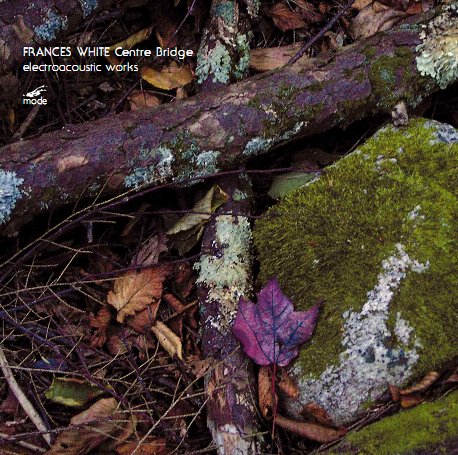
I first heard Frances White's music on a compilation album from an annual electroacoustic music competition in France. Cultures Electroniques 5 from 1991 contained Valdrada, a purely electronic piece as well as Still life with piano for piano and tape. I sought out the score for Still life, which became the first piece for piano and tape I ever played. A few years later, another prize-winning piece on Cultures Electroniques 10 cemented her position of respect with Winter Aconites, for chamber ensemble and tape. Winter aconites are small yellow flowers that spread across forest floors, one of the earliest harbingers of spring. I eagerly anticipated Centre Bridge, her first solo CD, released last fall on Mode Records, and have not been disappointed in the slightest. The five works on this CD continue in the same quiet vein as her earliest works which I had heard on the Cultures Electroniques.  Four of the pieces use instruments and tape, and the fifth piece is a rendition of an interactive installation she made in 1990.

Two of the pieces on the new CD are named Centre Bridge, and an essay in the liner notes by James Pritchett explains that this is a singing bridge across the Delaware River between New Jersey and Pennsylvania. Both pieces use field recordings from the bridge as part of the electronic backdrop. For the earlier of the two pieces, White transcribed and transposed the sound of the bridge for two shakuhachi, who call to each other across the sound spectrum. In a concert performance the two instrumentalists are on opposite sides of the stage, and in this recording the two voices (both played by Elizabeth Brown) are on opposite sides of the stereophonic field. The second recording, for string quintet and tape and subtitled Dark River, uses a bridge form very clearly, with water sounds on either end and a deep, quietly moving, complex drone in the middle. Centre Bridge (Dark River) is the highlight of the album, straddling the line between quiet menace and tranquillity. There is also a version of this piece for a string orchestra and electronics, where I imagine the senses would be heightened.

White occupies a unique place in contemporary composition. Inspired by a deep reverence for nature, her compositions move very slowly, with the instruments in an oblique relationship to the electronics, which are themselves often field recordings in various stages of recognition. Even the early piece Winter Aconites used small bell-like tones to represent the fields of bulbs and flowers that populate the early spring forest, and these sounds occur on this album as well. Pritchett points out that White has a "bulb series" of pieces that includes Winter Aconites and Like a Lily (for viola, double bass, and tape) from this album, and it's easy to hear the continuity between the pieces. Both of the Centre Bridge pieces use water sounds, and the piece A Veil Barely Seen, for viola and tape, is puts the viola in the middle of a stream for the entire duration. Like a floating leaf, the soloist takes a voyage through a dream-like sonic landscape, surrounded not only by the water sounds but also similar bell tones to the bulb works.

Centre Bridge is available as a download from emusic and iTunes, or as a CD from various outlets. Pritchett's essay is available with the CD (including French and German translations) and at White's web site (English only).

Tuesday, February 19, 2008

Listening to the fauna

Michael Prime was one of the founding members of the electronic improvisation group Morphogenesis, one of the few groups who traced their lineage to the live electronic music of Cage, Stockhausen, AMM and MEV instead of the more typical free jazz. Although the group still performs sporadically, Prime has continued a productive improvisational career as a soloist and with other improvisers such as Max Eastley, Jim O'Rourke, Eddie Prévost and Geert Feytons.

Similar to sound artist Francisco Lopez, Prime studied ecology and worked in the field for many years. Not only do field recordings find their way into his music, but he also developed an unusual method of sound production: bioelectrical signals from plants. Even with Morphogenesis, Prime could be seen (and heard) with various plants connected to wires. His solo work includes the album L-Fields where he manipulates bioelectrical signals from various hallucinogenic and psychotropic plants. In addition, he has also worked with ultrasonic recordings, capturing the sounds of fish, insects and bats. He also creates sound installations, one of which was released a few years ago in which live bioelectrical signals were modulated with infra-red motion detectors and eventually, interference from the audience.

His most recent solo work, Borneo, is a two-CD set stemming from a trip to the northernmost part of the island in early 2005. The album is an excellent summation of Prime's various creative activities to date. Several pieces combine bioelectrical plant signals with field recordings from the same area. The piece Insect Strategies combines ultrasonic recordings of various insects, while Hungry Ghosts includings ultrasonic recordings of bats. He even set up sound installations in the jungle and recorded these in combination with the field recordings. Some of the tracks are unadulterated field recordings from forests and markets. The album's opening piece, Year of the Cock, includes snippets from a Chinese New Year celebration, but the piece is a gentle introduction to the set as a whole, saving the bioelectrical sounds for the longer compositions scattered across the album.

The sounds themselves on the album range from the greatest delicacy to massive squalls of sound. The noisiest parts often come from the plant recordings, creating a disjointed image between the ferocious sounds emanating from the most pastoral and tranquil scenes. In this sense, Prime exposes a world that most of us never see or hear, similar in this effort to John Duncan's or Jonathan Coleclough's recordings based on tidal data. But Prime's goal is different in that his bioelectric recordings present real-time sounds from the environment, not data mediated and massaged into audible form. A closer parallel would be shortwave data, which Duncan has also used and which dates back to Morphogenesis (and Cage and Stockhausen before that). Shortwave radio pulls sounds from the radiophonic soup that surrounds us at all times and in all places, an audible reminder that we're never alone. But seldom do we get to hear messages from so foreign and so other a source as plants — although we all know they're alive, to most people they remain part of the inanimate environment.

In one of the most quixotic moves I've ever heard, for a couple of the pieces Prime went through the effort to set up installations in the jungle, which he then "stalked" (his word) with binaural microphones. The accompanying booklet even includes pictures of such installations. The action is reminiscent of the transient works of Andy Goldsworthy, a visual artist who creates ephemeral sculptures from natural materials available at the site, and whose works exist for most of us only through photographs. The paradox emphasizes the hidden nature of the sounds, brought forth by obscure processes on "previously undescribed species" of plants, created by stalking installations that practically nobody was there to hear. Trees falling in the forest indeed.

The packaging for Borneo shows great care and attention to detail. Prime includes a 16-page booklet of text and color photographs, including a short travelogue essay and some notes on each individual piece. Some of the tracks contain index points, and in the booklet the events at each index point are noted. Both CDs and the booklet come in a metal box along with a small envelope of tongkat ali, an Indonesian herbal product that comes with various life-affirming promises. The first hundred copies include a mini-CD containing an additional ultrasonic recording of bats.

Prime's recordings can be difficult to locate. None of them are available on iTunes or emusic, but the CDs are sometimes available from Mimaroglu or other online vendors. Neither Prime nor his label (Mycophile) have web sites, but I obtained my copy of Borneo directly from him.

Friday, January 11, 2008

Invisible sounds

One of the most interesting releases from 2007 was by the peripatetic sound artist Francisco López, entitled Wind [Patagonia]. It is the third in an occasional series of extended works constructed from relatively unprocessed field recordings from various locations in the western hemisphere. The label description refers to the three releases as the "trilogy of the Americas," but it is not only the sound origins that create a commonality between the works. Each one has a similar cover design and contains an extensive essay on how the work was created, along with the same cautionary warning in all three releases, providing the listener with information about "the background philosophy behind the work and about its specific spatial-temporal 'reality,'" but urging him or her not to access them. All this is very much in keeping with López's long term vision of 'absolute' music. In various essays and interviews, he has situated himself with reference to the work of musique concrète theorist Pierre Schaeffer, who used sound objects without reference to their origins in the 'real' world. López often blindfolds the audience at his concerts to de-emphasize the sounds' relationship to the performer.

López has been at the forefront of sound art for nearly twenty-five years. He originally trained as a biologist, spending considerable time in the Costa Rican rain forest La Selva where the first of the three recordings was made. La Selva is an amazing recording, bringing the rain forest to life through close-miking magic. At several points, the listener can hear insects landing on the microphone and taking off again, along with all of the other richness present in the ecosystem. The second recording was urban: Buildings [New York] captured the sounds of the city's infrastructure, including the World Trade Center. Both albums portrayed a detailed sonic environment, demonstrating the rhythmic and textural possibilities for a musical interpretation.

Although Wind [Patagonia] shares several aspects with the earlier releases, it seems to require a perceptual shift that is unique. It isn't simply that López has moved his focus from the closed spaces of the rain forest and sub-basements to the South American plains. One can hear various creaks and squeaks, but the overwhelming sound source on the album is, unsurprisingly, wind. Movement of air through empty space. The sound of something invisible, something that's not really there. A Google search for wind noise produces results that tell how to minimize and eliminate it. López turns the act of listening on its head by calling attention to the invisible, the ignored, the unseen. Even with this obscured sound palette, López has created a work as varied, as detailed and as rich as the other releases in the series. The great sweeps of white noise from the wind are complemented by tiny sounds from the rest of the environment, rewarding the listener who has successfully transferred the background to the foreground.

López is a prolific sound artist, with nearly fifty releases on CD alone. With his focus on sound objects, it's not always possible to identify his sound sources, but he casts a much wider net than field recordings. Nevertheless, these three albums are among his best and most accessible. Wind [Patagonia] is released on and/OAR, a small label specializing in field recordings, and is available directly from the label as well as from the usual gang of distribution suspects.

Friday, August 24, 2007

Synthesis from a diary

Most of the time, when I find a new discovery in the INA-GRM sound, a recognizable style of electronic music, often derived from Pierre Schaeffer's first musique concrète in the 1950s, the artist was active in the 1970s and 1980s, but his or her records were released in limited editions back in the day and never received any kind of circulation. The Icelandic label Creel Pone specializes in this mini sub-genre, duplicating the original releases as closely as possible except the LP is replaced by the CD (and the packaging reduced in size). Few are the releases of new work and new composers, but the Italian label Die Schachtel recently released a collection of pieces by Angelo Petronella that sits easily next to the French masters. As far as I can tell, this is his first release under his own name, although he participated in a new music/improv release from 1979 that has been given a deluxe reissue package, also from Die Schachtel.

Sintesi da un Diario (Synthesis from a diary) clearly inhabits the same sound world as Bernard Parmegiani and his colleagues. You can easily hear one big difference between this album and those from the seventies, and that is the precision Petronella gets from his material. This factor alone would make the album worth hearing — it sounds great, way better than most reissues, even after remastering. Razor-sharp sounds are carefully placed in space, even in the two-dimensional stereo reduction that comes on a CD. On headphones, you can hear sound gestures whirling around, coming from all directions. In addition, more than a lot of earlier composers, Petronella combines field recordings with electronic sounds in unusual and creative ways.

The album comprises a seven-part suite Insieme sonoro in quattro tratti e tre innesti (soundwork collection in four sections and three connections), preceded by the standalone piece, Voce e macchina (Voice and machine). Big Tibetan chants open this piece, intercut with delicate typewriters, helicopters, and other mechanical sounds. The two types of sounds carry on a dialogue that ranges in turn from ominous to sultry, sometimes morphing into each other.

In the suite, field recordings play a major structural role. Each of the four sections of the suite (named Tratto 1 through Tratto 4) incorporates the sounds of children playing, and each of the three connections is based around a different thematic, whether it's the illusion in Habitat of opening a window to the sounds outside, the conversations in Lamento, and the vocal phonemes in Un canto. Throughout the suite, the sounds swirl and blend together, precisely placed in space and with different degrees of resonance used to create visions of great depth. Electronic sounds seem to grow out of the field recordings, especially during the sections using the sounds of the children.

Many commentators have dismissed this album as derivative of the INA-GRM sound, but I think this perspective misses the point. Musique concrète remains a viable musical language with many different styles, and currently practiced by several artists (one thinks of Francisco López, Chris Watson, Michael Northam, and Steve Roden, to name only a few for whom field recordings are a rich source of sonic building blocks). Artists like Petronella keep the genre alive, and the technological advances in the studios over the last couple of decades make Sintesi da un diario a superb example of contemporary concrète.

Tuesday, February 13, 2007

Just Plain Sound

For those of us versed in the vocabulary of western art music, Bernard Parmegiani's music is extraordinarily difficult to write about. There isn't even a commonly accepted name for the genre, which is sometimes called electroacoustic or acousmatic music (music designed for playback through loudspeakers, as opposed to music played live by instrumentalists), or musique concrète (music which was completely comprised of samples of sounds from the real world, as opposed to sounds which were electronically generated). Parmegiani studied directly with Pierre Schaeffer, musique concrète's inventor, and his early work is musique concrète in the strict sense. But now he is a ProTools user, and some of the sounds in his recent work are almost certainly generated electronically. For some reason, the genre is peculiarly French, with nearly all the major practitioners located in France or Montreal. Similarly, all of the major theoretical writings on musique concrète are written in French, virtually none of which have been translated into English.

Parmegiani's most recent release, entitled Plain Temps (which is sometimes hyphenated Plain-Temps on the cover, and sometimes not) is a suite of three pieces on the subject of time composed in the early 1990s, with the first and last pieces in the suite revised in 2006. The first piece, Le Présent Composé was released on his Violostries album a few years ago, but the other two pieces have not been previously issued on CD. The liner notes are in English and French, but the French texts are impressionistic and poetic, and the English often badly translated (e.g., "Things we do automatically or deliberately, the aim of which is the inflect the instant towards a composed continuity." Clear?) It might be more helpful if the English-language notes explained some of the peculiarities of the titles. The title of the first movement might be translated as The Composed Present, the second movement as In the Meantime, and the third movement (and for the suite as a whole) as Just Plain Time. But there are all kinds of additional meanings. The passé composé, or composed past, is one of two primary grammatical tenses in French to indicate an event in the past, and it is used to refer to events that took place at a particular moment in time (as opposed to the tense used to describe trends that took place over an indefinite period). And the title for the suite, Plain Temps, is a homonym for Plein Temps, which means a full day's work.

The earlier version of Le Présent Composé on Violostries was subdivided into four named sections, but all mention of the subdivisions have been removed on the new release, even though the silent separations still exist. After an annunciation chord, we hear a door opening and creaking on its hinges, with the last squeak prolonged and resonating as the annunciation is repeated, adding more and more overtones to the drone. The squeaking door is not only an auditory cue to enter Parmegiani's sound world, but is a reference to one of the pioneering works in the genre, Pierre Henry's Variations on a Door and a Sigh from 1963. The door will return throughout the piece, as the listener goes from one of Parmegiani's cinematic rooms to the next. The movement gets quite thick, with the high-pitched whistling layered on top of electronic percussion sounds. Very otherworldly, and it doesn't really sound like anything else. I hear several different layers in the music, but I can't relate it to any kind of human agency, but little sound figures recur often enough to keep the music from being completely disorienting. Parmegiani's music isn't disorienting, exactly, but I can't imagine humans playing it. A number of different groups have experimented with transcribing electronic music for acoustic instruments (such as the Italian musician Marco Lucchi, Bang on a Can with Eno's Music for Airports or the London Sinfonietta's work with Aphex Twin's music), but I can't imagine what instruments or notation that one might use for this.

The second movement, Entre-temps, opens with an amazing interplay between a ticking clock, turning pages, and background noise from general human activity. The middle of this movement is a long meditation developing a sound that reminds me of a wooden ball in a spinning roulette wheel. But the page turns again, and we're back in a world of whistling sounds, perpetually rising and fading away. In the climactic last minutes of the movement, all of the preceding sounds come together and in a mysterious blend over a slow heartbeat before the ticking clock returns at the very end.

The eponymous third movement opens with sounds that remind me of seagulls circling overhead, and perhaps these were the whistling sounds in the second movement. Several of the sounds introduced in the earlier movements reappear here, reminding me of a passage from Harry Mulisch's novel The Assault:

Whenever he thought about time,... he did not conceive of events as coming out of the future to move through the present into the past. Instead, they developed out of the past in the present on their way to an unknown future.

Although the third movement is generally quieter than the preceding two, the work closes with the resonating squeaking door that opened the first movement, tying all three movements together into a unified whole.

In Parmegiani's music, the traditional musical elements of pitch, harmony, and pulse are replaced by a play of dynamics, gestures, timbres and resonances. His sounds extend themselves in unique and remarkable ways, as with the squeaking door whose resonance grows to fill the entire sound spectrum, or the wooden ball skittering over the pockets on the roulette wheel. These elements take the place of melodic themes in orchestral music, but retain the same degree of complexity and interest for the listener.

One of the aspects of drone music that most appeals to me is the absence of a pulse, or at least of the binary pulse that stems from activities that we undertake as symmetrical beings, such as walking and dancing. One of musique concrète's epiphanies was the combination of removing the attack from a sound and putting the resonance in a locked groove, which enabled the listener to hear the inner workings of the sound during its potentially infinite repitition. Parmegiani's squeaking door and other drones extend this same insight. The sophistication of his tools permits not only a deeper investigation into a sound's resonance, but also provides the ability to layer many different sound objects in a much more polyphonic fashion than he could on his earlier works.

He also manages to put percussive and rhythmic events in his music without adding a pulse. Inevitably, something of the event persists and resonates, which gives his music a sense of space that I find exhilarating. His drones are more investigations and prolongations of the resonance of his sounds, but his percussive sounds are fascinating in themselves as they provide melodic and rhythmic contours to the music.

Parmegiani's music, like much of the musique concrète genre, is cinematic in the way it uses time. Most pop music, with its rock steady beat, moves at a fairly consistent rate. By combining silence in a sparse listening field with sound objects of great rhythmic flexibility and sophisticated melodic contours, Parmegiani slows down our perception of time, makes it seem to move more slowly, so that our senses are heightened waiting for the next sound events. Music psychological studies have shown how sensitive human hearing is for discrete sound events and different reverberations, and in Plain Temps Parmegiani spreads around his sounds in space and uses the objects' reverberations as compositional elements so our hearing becomes more acute, with listening and understanding following close behind.

Plain Temps is available from Forced Exposure and better music stores.